


Introduction
Over the last few months, I’ve been mentoring startups in incubation and acceleration programs.
Most of these teams are led by brilliant technical founders who have built something genuinely impressive. Their products are solid, sometimes even remarkable. But when we start talking about what comes next, it quickly becomes clear that their biggest challenge isn’t about refining the product—it’s about learning how to sell it.
The programs I support are generally designed to help founders prepare investor materials: pitch decks, executive summaries, financial models. Yet, more often than not, the real work should start much earlier—with understanding how to take their product to market and talk to real customers.
That’s why I often end up shifting the conversation from “How do we raise money?” to “How do we make money?” In other words: how do we sell?
I’ve come to believe that for most early-stage startups, especially those led by technical founders, the first sales motions are crucial. It’s where assumptions are tested, narratives are challenged, and reality replaces theory. And while it might feel uncomfortable, it’s also where a startup truly begins to understand its market—and itself.
This article was born out of that experience. You can think of it as a roadmap for founders before their first sales hire—a practical guide you can come back to whenever you need direction while navigating your first customer conversations, experiments, and deals.
If you’re a technical co-founder with limited time, limited budget, and limited selling experience, this is written for you. You don’t need to become a professional salesperson. You just need to learn how to lead the first sales motions until the company is ready to scale that function.
The goal here is to make the process of selling less mysterious, less intimidating, and—occasionally—almost enjoyable.
Let’s Be Honest About Sales
If you’re new to sales, your perception of it might be shaped by clichés: pushy people, forced smiles, and endless follow-ups. The truth is, early-stage selling looks nothing like that.
At this stage, sales is not about closing deals—it’s about learning. It’s about discovering who your customers really are, what they struggle with, and how your product fits into their world. Each conversation becomes an opportunity to refine your message and your product at the same time.
That’s why, before hiring anyone to sell for you, you need to do it yourself.
As a founder, at this stage you’re the bridge between what’s being built and what the market actually needs. You can’t skip this step. If you hire someone too early, hand them a product still in motion, you’ll likely watch both struggle to make progress. It’s not that the hired salesperson is bad—it’s that you haven’t yet learned how the product should be sold.
So, if you’re still refining your value proposition, identifying your ICP, or searching for product-market fit, selling isn’t a job you can delegate. It’s part of your own discovery process.
The Good News
If sales feels like a foreign language, you’re not alone—and it’s not an innate talent. It’s simply another skill you can learn.
You’ve already learned to code, design, build, or lead a team. Selling is just another domain of problem-solving, one that requires curiosity, empathy, and structure more than charisma or persuasion.
You’ll learn to ask better questions, listen carefully, and interpret what customers mean—not just what they say. You’ll make mistakes, and that’s fine. Each one will teach you something about your market, your product, or yourself.
What My Article Series Will Help You Do
This guide will walk you through what early-stage selling really looks like—from the first awkward calls to the moment you start to see repeatable patterns. Along the way, we’ll cover:
How to adopt the right mindset for founder-led sales.
How to build your first sales narrative—a story customers actually care about.
How to talk less and listen better, turning conversations into insights.
How to price your product without losing confidence or giving it away.
How to record and systematize what you learn so future hires can build on it.
And finally, how to recognize the early signs that it might be time to bring in your first salesperson—when the process starts feeling more repeatable than experimental.
This isn’t a crash course in sales tactics or negotiation techniques. It’s more of a field guide for navigating uncertainty, based on what founders actually go through in the early go-to-market phase.
If you’re still figuring out who your customers are, how to talk to them, or what value they truly see in your product—this article is for you.
Think of it as a conversation with someone who’s seen this journey already and wants to help you avoid the most painful mistakes.
You don’t need to love selling. You just need to understand it enough to make it work for you.
So, let’s begin—step by step.
Chapter 1 — Reality Check: You Built It, But They Won’t Come
Let’s start with the uncomfortable truth: nobody cares that you built something amazing.
Not yet, at least.
The harsh reality for most first-time founders is that building a great product and getting people to buy it are two entirely different things. The “if you build it, they will come” mindset might work in the movies, it rarely works in business.
Early-stage sales — what I call the evangelical phase — looks nothing like the polished, professionalized version you might see in large companies. It’s messy, personal, and highly experimental. You’ll do things that don’t scale, that can’t be automated, and that often feel inefficient or uncomfortable. But that’s precisely the point.
At this stage, you’re not scaling success; you’re discovering what success looks like.
The Founder-Led Sales Myth
Many founders assume that once their product is ready, the next logical step is to “hire someone for sales.” That assumption can be dangerous — and often fatal for early-stage companies.
Professional salespeople are great at executing a proven process. They need a clear value proposition, a defined customer profile, and a pitch that’s already been tested in the wild. But if you’re still trying to figure out who your customers are, why they need what you’ve built, and what they’re willing to pay for it, there’s nothing to execute yet.
You don’t need a closer — you need a translator between your product and the market.
And right now, you are that translator.
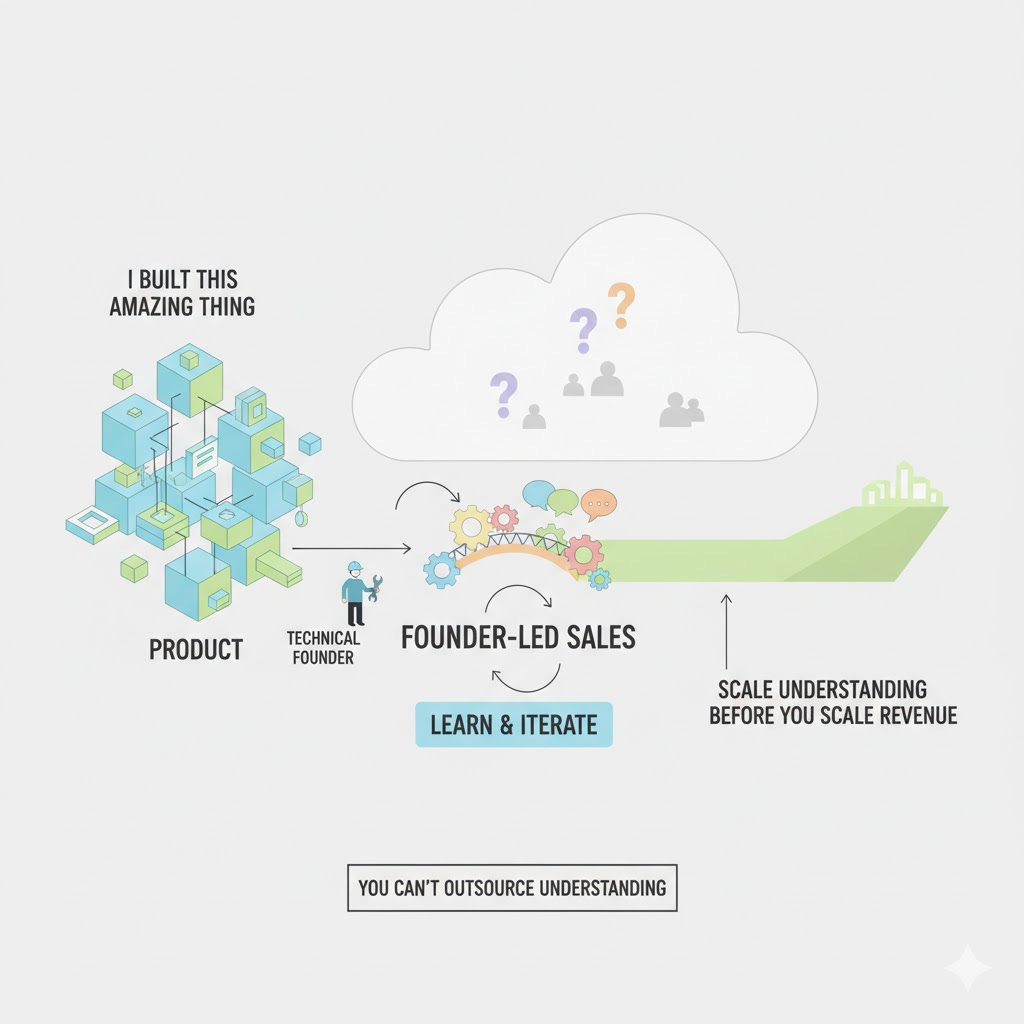
Founder-led selling isn’t about becoming a “salesperson.” It’s about gathering direct, unfiltered information from your potential customers. It’s about learning what works, what doesn’t, and what you still need to build. Every conversation you have now becomes the foundation of your future sales process.
💡 Takeaway: You can’t outsource understanding. Founder-led sales aren’t optional; they’re the foundation of everything that follows.
Why This Phase Feels So Strange
If your background is technical, selling might feel awkward at first — even unnatural. You’re used to logic, clean feedback loops, and measurable results. Sales offers none of that.
You’ll have conversations that seem promising and then die out. Prospects will say “this sounds great” and never reply again. People will ask for more information and then ghost you. It’s easy to take it personally, but this chaos is actually data.
Every “no” tells you something valuable. Every “not now” reveals a hidden constraint. Even silence has meaning — it shows you what doesn’t resonate.
Your goal in these early sales conversations isn’t to convince or close. It’s to discover alignment — to find the people whose world makes more sense once your product exists in it.
💡 Takeaway: Early sales are less about persuasion and more about discovery.
What This Stage Really Looks Like
This first phase of selling is, by nature, unscalable. You’ll do things that would never make sense later on — visiting a potential client just for a short demo, building a one-off prototype for feedback, or manually collecting leads one by one.
And that’s fine. In fact, it’s necessary.
You’re not optimizing for efficiency yet. You’re optimizing for learning — compressing the distance between your assumptions and the market’s reality.
Think of it like field research: you’re in discovery mode, observing how real people react to what you’ve built. Every small conversation, demo, or trial helps you test a hypothesis about your product and your value proposition.
💡 Takeaway: Early sales are product research with invoices attached.
The Danger of Hiring Too Early
It’s tempting to think that a professional salesperson could do this faster or better than you. In reality, hiring too early can set you back months.
Imagine you bring in an experienced seller from a larger company. They’re used to working with clear playbooks, mature products, and defined metrics. When they join your startup, they find a moving target: the product changes weekly, the pitch evolves daily, and nobody really knows who the ideal customer is.
They start reaching out to prospects, but can’t quite explain the problem your product solves. They get feedback you don’t know how to interpret. Deals stall, nobody’s sure why, and frustration builds on both sides. Eventually, they leave — and you’re left thinking, “Maybe the market isn’t ready,” when the real issue was that you weren’t ready to scale.
Until your narrative, audience, and early proof points are clear, no one else can sell effectively for you.
Your Early Sales Job Description
In these first months, your “sales” work isn’t about closing deals. It’s about understanding the landscape.
Think of yourself as part detective, part product manager, part anthropologist.
Here’s what the job really entails:
Exploration: Identify who might benefit from what you’ve built, and why.
Conversation: Reach out, ask thoughtful questions, and test different ways of framing the problem.
Observation: Listen for patterns — what resonates, what confuses, what excites people.
Iteration: Adjust your product, your story, or both, based on what you’ve learned.
That’s it. No scripts, no funnels, no dashboards. Just you, your curiosity, and your willingness to learn.
💡 Takeaway: Founder-led sales are structured curiosity in action.
The Emotional Rollercoaster
Let’s be honest: selling something you’ve built can be emotionally draining. When a prospect says “not interested,” it can feel like they’re rejecting you. They’re not. They’re rejecting the version of your story that didn’t quite click.
The key is to stay analytical, not defensive. Treat rejection as feedback. Just like debugging code, you’re identifying where the error is — in your messaging, your targeting, or your assumptions.
Some of your early conversations will be energizing. Others will be frustrating. A few will leave you wondering if you’re cut out for this. But over time, you’ll develop instincts: which prospects are worth pursuing, which objections actually hide curiosity, and which “no” really means “not yet.”
That intuition is one of the most valuable assets you’ll ever develop as a founder.
What Progress Looks Like
In this stage, success isn’t about revenue targets. It’s about gaining speed and clarity.
Ask yourself:
Am I starting to recognize which types of customers react positively to my message?
Can I explain what I do in a way that makes sense to someone outside my field?
Do I understand which objections come up repeatedly, and why?
If you can answer yes to those, you’re on the right track. The deals you close are nice milestones, but the real win is pattern recognition. Once you start seeing the same signals repeat — similar profiles, similar needs, similar objections — that’s when you know you’re approaching something that can be scaled.
In Summary
You can’t delegate understanding your customers. You can’t automate empathy and relationship-building. And you can’t skip this phase by hiring someone else to do it for you.
In these early months, selling is learning. Every conversation is an experiment, and every outcome — good or bad — brings you closer to clarity.
When prospects start echoing your message back to you, when objections become predictable, when your product finally seems to “click” with a specific type of customer — that’s the moment you’ll know you’re ready to take the next step.
Until then, keep showing up, keep listening, and keep learning.
Because nobody will ever care about your product as much as you do — and that’s exactly why you’re the right person to sell it right now.
💡 Takeaway: Before you scale revenue, scale understanding.
Massimiliano Pani is a Sales and Customer Success expert and Founding Member of Quiet Edge, based in Mallorca, Spain. With nearly a decade of experience spanning the full sales spectrum—from business development to enterprise sales—he now focuses on helping technical founders navigate their first sales motions. Follow him on LinkedIn.