


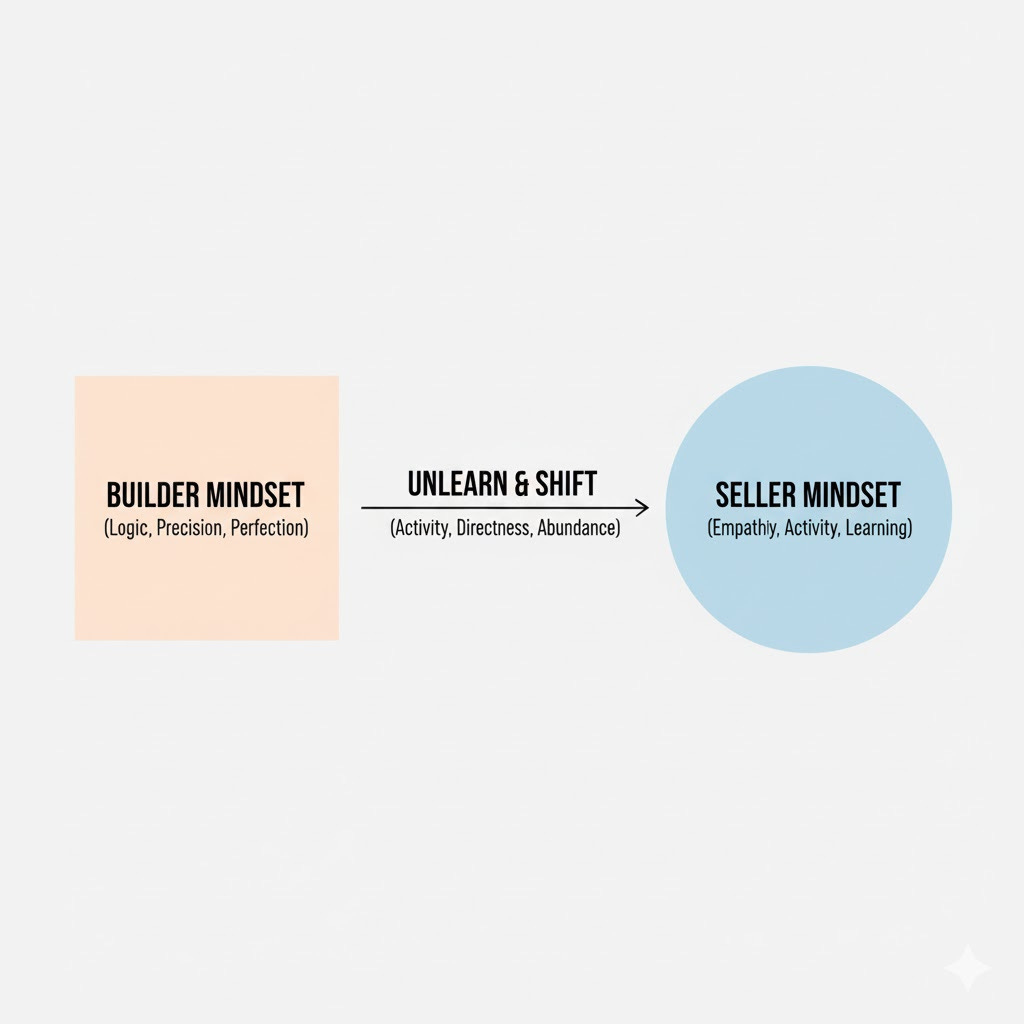
Chapter 3 — Mindset Makeover: Unlearning Everything You Know
Selling for the first time as a founder isn’t just about learning new skills — it’s about unlearning old habits.
The mindset that makes you a great builder can make you a terrible salesperson. You’re used to solving problems logically, optimizing systems, and aiming for precision. Sales, on the other hand, is gloriously imprecise. It lives in the world of human emotion, imperfect communication, and unpredictable timing.
That’s not bad news — it’s just different physics. To succeed in this phase, you have to shift how you think.
Here are some of the key mental adjustments that will help you navigate this transition from builder to seller.
1. From Scarcity to Plenty
Most founders start out treating every lead like it’s the last one on Earth. They hold onto conversations that clearly aren’t going anywhere, just in case. They send follow-up after follow-up, even when the other side has gone silent. They treat every prospect like a once-in-a-lifetime opportunity.
But this scarcity mindset does more harm than good. It drains your energy, and stops you from focusing on the opportunities that actually matter.
Here’s the truth: in most markets, there are plenty of potential customers. If one conversation isn’t progressing, it’s not a failure — it’s information. The goal isn’t to close every deal; it’s to identify which deals are worth pursuing now and which ones can wait.
Adopt a mindset of abundance: “If not this one, then the next.” That doesn’t mean being careless — it means being selective. Respect your time as much as you respect your prospect’s.
💡 Takeaway: The world is full of potential customers. Spend your time with the ones who want to spend theirs with you.
2. From Perfection to Activity
As a founder, you’ve probably been told to “think before you act.” In product development, that’s wise advice. In sales, it’s a trap.
If you overthink every email, every demo, and every message, you’ll spend more time preparing than actually selling. Early sales are a game of volume and momentum — the more conversations you have, the faster you learn.
You don’t need the perfect pitch or the perfect shiny Sales Deck. You need…ten imperfect conversations that teach you something new.
This is not an excuse for sloppiness, but a call to action. Stop polishing; start talking.
Send the email. Make the call. Run the demo. Then adjust based on what you learn. You can’t iterate on silence.
💡 Takeaway: Progress beats perfection. Activity is your best teacher.
3. From Politeness to Directness
In everyday life, we often dance around uncomfortable topics to stay polite. We hint, we suggest, we avoid being too forward. In sales, that doesn’t work.
You have limited time, and so do your prospects. Your job is to get to the truth — quickly, respectfully, and clearly. That means asking direct questions:
“Is this a real priority for you right now?”
“Who else would be involved in the decision?”
“If this problem remains unsolved, what happens next quarter?”
These are not pushy questions. They’re professional ones. They show that you respect the other person’s time and want to understand whether it makes sense to keep talking.
Being direct also means being confident enough to ask for the sale when the time comes. Not with pressure, but with clarity: “I think we can solve this for you — should we move forward?”
💡 Takeaway: Clarity is kindness. Be direct, not pushy.
4. From Deep Relationships to Many Light Ones
When you’re used to working in small, tight-knit teams, you naturally invest deeply in relationships. Sales requires a different rhythm. You’ll be having dozens of conversations at once, often with people you’ve only just met.
At first, this can feel shallow — like you’re speed-dating for business. But this is how pipelines are built. Each relationship starts as a small spark; only a few will grow into meaningful partnerships. Your job is to light many matches and see which ones catch.
To stay organized, keep notes. Track who you spoke with, what they said, and what the next step is. Over time, you’ll build a living map of your market — one conversation at a time.
💡 Takeaway: In early sales, depth comes later. Start wide.
5. From Fear to Expertise
If you’ve never sold before, your first few conversations will probably feel awkward. You’ll worry about saying the wrong thing, asking the wrong question, or looking inexperienced. That’s normal — and temporary.
Embrace the suck: the antidote to fear is expertise. The more you understand your customer’s world, the more confident you’ll become in speaking their language. Read what they read. Follow the conversations they’re having online. Learn about the challenges that shape their day.
You don’t need to know everything. You just need to know enough to be helpful. Over time, this builds authority — not because you’re pretending to be an expert, but because you genuinely understand the terrain.
When you speak from expertise, confidence follows naturally.
💡 Takeaway: Fear fades as knowledge grows.
6. From Privacy to Transparency
In most jobs, your work is relatively private. You write code, design features, or analyze data quietly until you’re ready to show the result. In sales, everything is visible — and immediate.
Your calls, your emails, your metrics, your wins and losses — all of it can be tracked, shared, and scrutinized. For a founder, this can feel exposing at first. But transparency isn’t the enemy; it’s an accelerator.
Recording what you do and sharing what you learn helps the entire organization grow. It also builds accountability — for yourself and, eventually, for your future team.
Start documenting early: notes from calls, reasons for wins and losses, customer objections, and recurring themes. These records will later become gold when you’re onboarding your first salesperson or refining your pitch.
💡 Takeaway: Transparency turns individual learning into organizational knowledge.
7. From Art to Math
When people think of sales, they imagine charisma and persuasion. While those help, sales at its core is a numbers game. There’s art in the conversation, but the engine that drives it is math.
You’ll need to start thinking in terms of ratios:
How many emails or calls lead to a meeting?
How many meetings turn into proposals?
How many proposals close?
These ratios tell you where to focus. If your close rate is high but meetings are rare, you have a lead generation problem. If you book lots of meetings but rarely close, your narrative might be off.
Tracking these numbers doesn’t make you robotic; it makes you effective. And the earlier you start, the more clarity you’ll have when you eventually build a team.
💡 Takeaway: Sales is a system. Learn the math, not just the story.
8. From Ego to Learning
Finally — and perhaps most importantly — selling as a founder requires humility. You will get things wrong. Often. You’ll misjudge interest, stumble through demos, and hear “no” more times than you’d like.
That’s not failure; that’s data. Every “no” teaches you something about what your market values, how people make decisions, and how your product fits (or doesn’t yet fit) into their world.
Approach sales as an ongoing experiment. Be curious, take notes, and resist the urge to defend your product when someone criticizes it. Listen instead — because that criticism is usually a map to your next iteration.
💡 Takeaway: Ego resists feedback. Learning depends on it.
Putting It All Together
The transition from founder to seller isn’t about personality; it’s about perspective. You’re learning a new way to solve problems — not through code or design, but through conversation, empathy, and iteration.
When you adopt these new mindsets, selling stops feeling like a foreign language. It becomes another form of problem-solving — one that connects the dots between your work and the world it’s meant to serve.
You’ll notice the shift when:
You stop trying to convince and start trying to understand.
You stop fearing rejection and start craving feedback.
You stop optimizing for perfection and start optimizing for movement.
That’s when you’ll realize that sales isn’t a separate discipline after all — it’s just another way of building.
💡 Final Takeaway: To sell well, you don’t need to change who you are — you just need to update your mental software.
Massimiliano Pani is a Sales and Customer Success expert and Founding Member of Quiet Edge, based in Mallorca, Spain. With nearly a decade of experience spanning the full sales spectrum—from business development to enterprise sales—he now focuses on helping technical founders navigate their first sales motions. Follow him on LinkedIn.