

Chapter 4 — Crafting Your Sales Story
You’ve accepted that you have to sell. You’ve started talking to people, listening, and learning. Now comes the next big challenge: explaining what you do in a way that makes sense to someone who doesn’t live inside your head.
Technical founders often struggle here. You know your product better than anyone, but that knowledge can work against you. You’ve spent months (maybe years) thinking about features, design decisions, and integrations — all the intricate details that make your product unique. But customers don’t buy details. They buy outcomes.
This chapter is about learning to speak their language. Not the language of frameworks, APIs, or product specs — but the language of value.
The Problem with Explaining What You Do
Ask a technical founder what their startup does, and you’ll often get something like this:
“We’ve developed a machine-learning platform that optimizes edge computing workflows by integrating predictive analytics across IoT ecosystems.”
Now, ask the same founder what problem it solves, and there’s a pause.
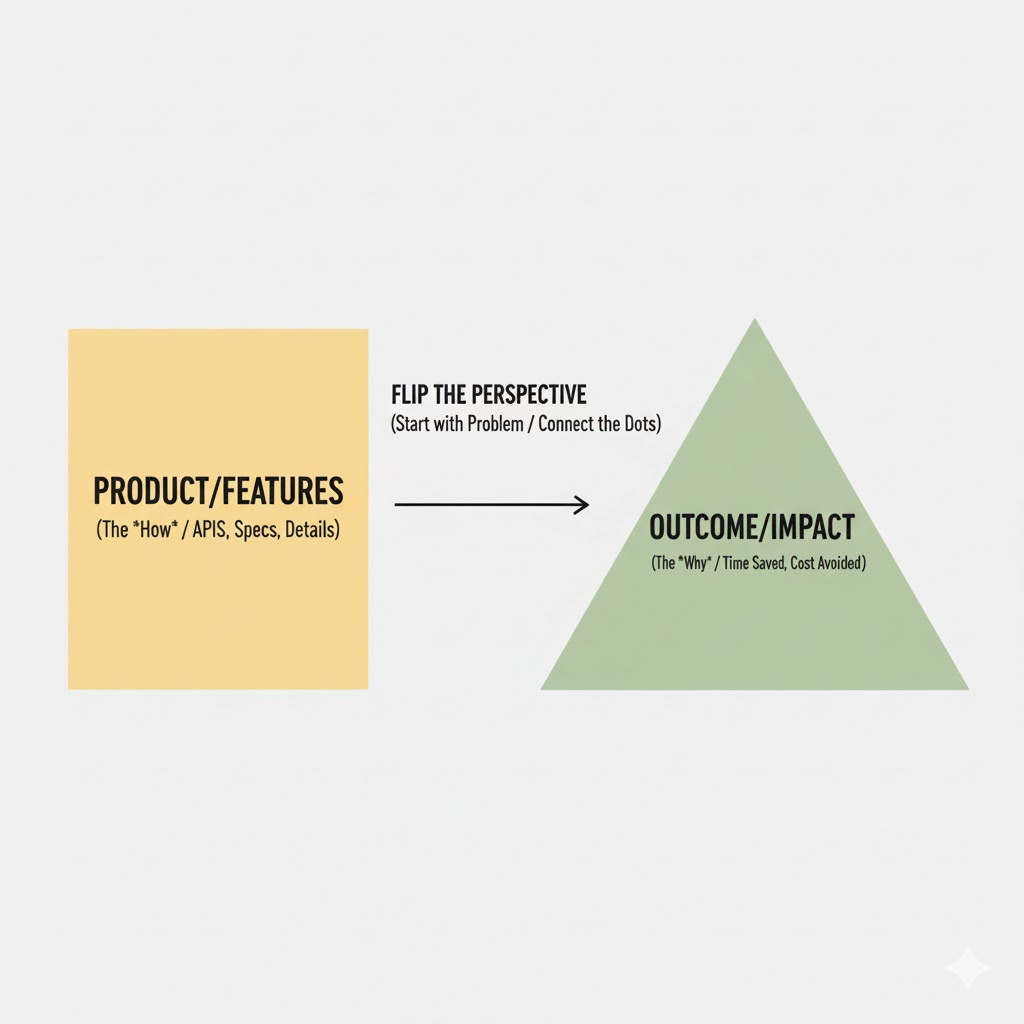
It’s not that the founder doesn’t know — it’s that they’re explaining the how, not the why.
Customers don’t wake up thinking about predictive analytics or IoT ecosystems. They wake up thinking, “My operations are too slow,” or “Our costs keep rising.”
So your job isn’t to explain how clever your product is. It’s to connect the dots between your cleverness and their daily headaches.
💡 Takeaway: If your customer has to ask, “So what does that mean for me?”, you’re not done crafting your story yet.
From Product to Problem
The easiest way to build a sales story that works is to flip your perspective. Instead of starting with your product, start with your customer’s world.
Ask yourself:
What’s the pain they feel most acutely?
What’s frustrating them about the way things work today?
What do they want more of — or less of?
Once you understand that, your product becomes the bridge between their problem and a better future.
Let’s take an example. Suppose your startup has built a new analytics dashboard for industrial machines. You could say:
“We use AI to collect and analyze sensor data in real time.”
Or you could say:
“We help plant managers spot machine failures before they happen, so they can avoid costly downtime.”
One describes technology. The other describes impact. Guess which one your customer cares about?
💡 Takeaway: Customers don’t buy features. They buy better versions of themselves.
The Simple Story Framework
You don’t need a marketing degree to tell a compelling story. You just need structure.
Here’s a simple, founder-friendly framework that works across almost any product:
The Problem: What’s broken or painful in your customer’s world?
The Impact: What happens if they do nothing?
The Shift: What’s changed that makes your solution relevant now?
The Solution: How do you fix it — simply and clearly?
The Proof: What evidence do you have that it works?
The Payoff: What’s the benefit — time saved, money earned, frustration avoided?
This structure works because it mirrors how humans process stories: we respond to tension, change, and resolution. Your customer should recognize themselves in the story you tell — not as a spectator, but as the protagonist.
💡 Takeaway: You’re not the hero of the story — your customer is. You’re the guide who helps them win.
Learning to Speak Human
One of the hardest habits to break for technical founders is speaking in abstract or overly precise terms. Precision is great for debugging, but terrible for storytelling.
For example:
Instead of “data normalization,” say “getting your data to speak the same language.”
Instead of “predictive maintenance,” say “fixing things before they break.”
Instead of “automated onboarding workflows,” say “getting new users up and running in minutes.”
Clarity beats sophistication every time. Your audience isn’t dumb — they’re just busy. The clearer you are, the faster they understand the value.
💡 Takeaway: If a smart 12-year-old can’t explain what you do after hearing it once, you’re not being clear enough.
How to Test Your Story
You’ll know your story works when you start hearing the same reaction again and again — “That makes sense.” Until then, treat every conversation as an experiment.
Here’s how to test and refine your narrative:
Record what lands. Notice which parts of your explanation make people nod or lean forward.
Watch for confusion. If someone furrows their brow or asks “Wait, how does that work?”, that’s your cue to simplify.
Listen for echoes. When customers start describing your product in their own words — and those words sound like your pitch — you’ve nailed it.
The best stories evolve. Don’t get attached to your first version. You’ll rewrite it many times as you learn more about your customers’ priorities and language.
💡 Takeaway: Your story isn’t written in slides. It’s written in conversations.
Using Stories, Not Stats
Founders often overestimate the persuasive power of numbers. They’ll pack their pitch with percentages, benchmarks, and metrics. While those are useful later, they rarely move people at the start. Numbers tell us what happens, words tell us what those numbers really mean.
Humans make decisions emotionally first and rationally second. That means a real customer story — a concrete example of someone who solved a painful problem using your product — is far more powerful than a slide full of data points.
For example:
“One of our customers used to spend two days a week compiling reports manually. With our platform, they do it in under an hour.”
That’s not a case study; that’s a picture. And pictures stick.
💡 Takeaway: Stories create memory. Stats only confirm belief.
The Role of Proof
Even in early-stage selling, you’ll need some form of proof to make your story credible.
That proof doesn’t have to be a long list of logos or a published case study. It can be as simple as:
A testimonial from an early user.
A pilot result, even if it’s small.
A before-and-after metric you measured yourself.
The goal isn’t to impress — it’s to reassure. Your prospects need to feel that someone else has tried this before and benefited. It’s social validation, not statistical significance.
💡 Takeaway: Proof builds trust faster than polish.
Evolving Your Story Over Time
Your sales story isn’t static — it evolves as your company grows and your market matures.
In the beginning, it’s about vision and possibility. Later, it becomes about results and scale.
At first, you might say:
“We’re helping small teams automate what used to take days.”
Later, you might say:
“We help organizations save hundreds of hours each month by automating their workflows.”
The difference is subtle but important. The first speaks to early adopters who are willing to take a chance; the second speaks to pragmatic buyers who want evidence. You’ll shift naturally from one to the other as your proof points grow.
💡 Takeaway: Early stories sell belief. Later stories sell results.
In Summary
Crafting your sales story is about empathy, not eloquence. You’re not trying to sound impressive — you’re trying to sound relevant.
When you speak in your customer’s language, they stop seeing your product as a novelty and start seeing it as a solution. That’s when real traction begins.
To recap:
Lead with problems, not features.
Speak in clear, concrete terms.
Make your customer the hero.
Use stories to make the value tangible.
Keep testing and refining as you go.
Remember: a good story doesn’t just explain what you do — it helps others believe in it. And belief, more than logic or features, is what turns interest into action.
💡 Final Takeaway: The best sales story is the one your customers start telling for you.
Massimiliano Pani is a Sales and Customer Success expert and Founding Member of Quiet Edge, based in Mallorca, Spain. With nearly a decade of experience spanning the full sales spectrum—from business development to enterprise sales—he now focuses on helping technical founders navigate their first sales motions. Follow him on LinkedIn.