

Chapter 5 — Learning to Listen (and Shut Up)
By now, you’ve accepted that you have to sell, started doing the work that doesn’t scale, and built a clearer story about what you offer. Now comes the hardest part for most founders — especially technical ones: learning to listen.
This might sound simple, even obvious. But in practice, it’s one of the hardest habits to build. Most founders love to talk about their product. After all, it’s the result of their hard work, late nights, and conviction. The temptation to explain everything — every feature, every design decision, every “why” — can be overwhelming.
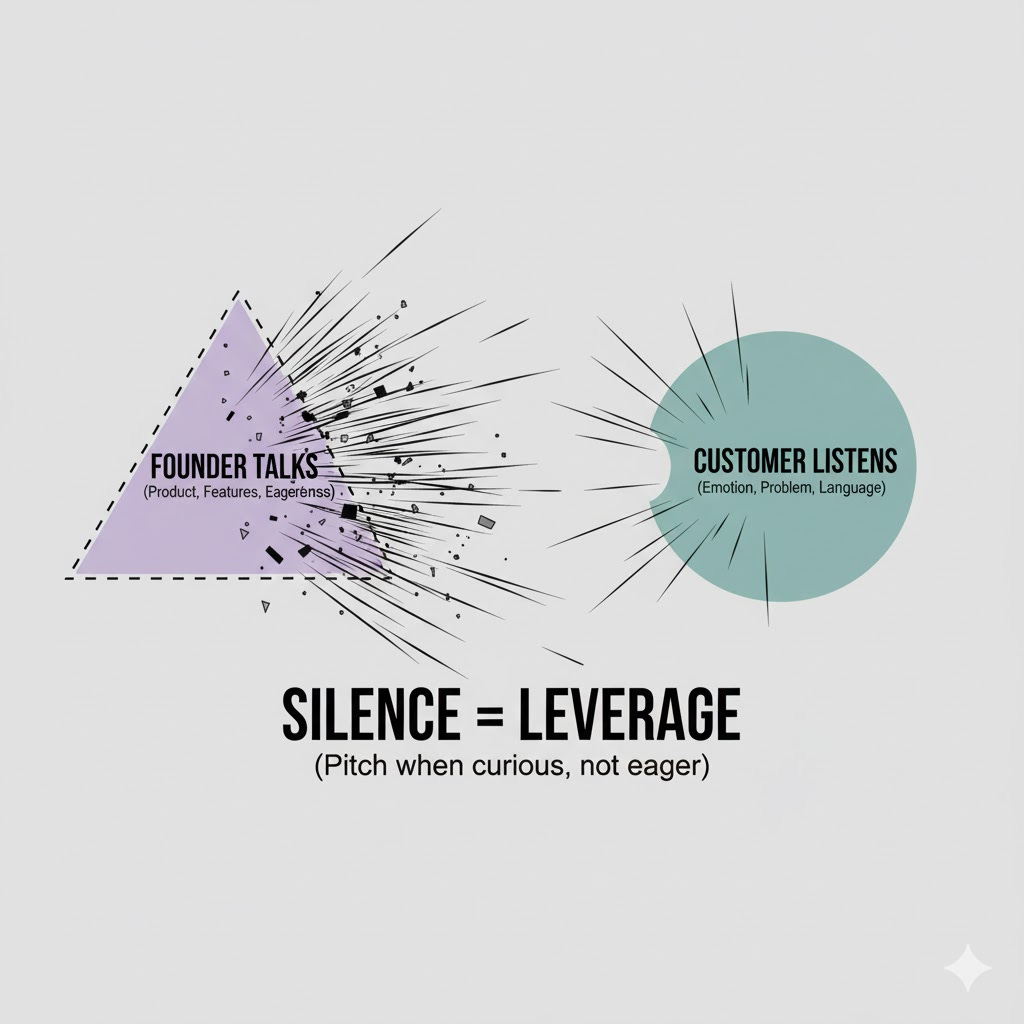
But the truth is this: the more you talk, the less you learn.
Why Founders Struggle to Listen
The challenge isn’t ego (well, not only that). It’s energy. You’ve been living inside your product for so long that you naturally want to share its brilliance with others. You want them to see what you see.
The problem is that customers rarely follow that path. They’re not there to admire your creation; they’re there to solve their own problems. And if you spend too much time pitching, you’ll miss the cues that tell you what those problems really are.
In early-stage selling, talking is tempting, but listening is leverage.
💡 Takeaway: You already know your product. What you don’t know — and need to learn — is your customer.
The Goal of Every Conversation
The purpose of an early sales conversation isn’t to impress someone. It’s to learn something.
You’re trying to uncover:
What problems they actually have.
How they describe those problems.
How they’ve tried to solve them before.
What would make them care enough to take action now.
Every question you ask should bring you closer to understanding whether your product fits into their world — and how.
Approach it like an investigation. You’re not there to perform. You’re there to collect clues.
💡 Takeaway: Your job isn’t to convince — it’s to understand.
How to Ask Questions That Actually Work
There’s an art to asking good discovery questions. Too vague, and you’ll get useless answers. Too specific, and you’ll bias the response. The sweet spot is open, clear, and neutral.
Here are some examples that work well:
“Can you walk me through how you handle this today?”
“What’s the most frustrating part of that process?”
“If you could wave a magic wand, what would you want to fix first?”
“Who else is affected when this doesn’t work?”
“What happens if nothing changes in the next few months?”
Notice what these questions have in common: they’re curious, not leading. They create space for the other person to talk — and for you to listen.
💡 Takeaway: Ask questions that make people think, not defend.
The Power of Silence
Silence is uncomfortable — which is exactly why it works.
When you pause after asking a question, the other person will often fill the space with what they really think. Those extra few seconds are where the truth lives — the part they didn’t plan to say.
Train yourself not to rush in. Let the silence do some of the work. You’ll be amazed how often the most valuable insight comes right after you stop talking.
💡 Takeaway: Silence is not awkward. It’s your most underrated tool.
Listening for Emotion, Not Just Information
Good sellers don’t just hear words; they notice energy. When someone’s tone changes, when they hesitate, when they repeat a phrase — that’s your signal. Those moments often point to something deeper than what’s being said!
If a prospect casually mentions, “Yeah, that’s always been a bit of a pain,” stop and explore it. That’s not a throwaway comment — it’s an open door. Ask, “Tell me more about that.”
Behind every emotional cue is a problem that matters. And problems that matter are where deals begin.
💡 Takeaway: Where emotion appears, opportunity lives.
Don’t Be a Therapist — Be a Translator
Listening doesn’t mean turning every call into a therapy session. Your goal isn’t to nod sympathetically while your prospect vents. It’s to translate what you hear into actionable insights that shape how you position your solution.
As they describe their struggles, try to frame their words into your structure:
What’s the root cause of this pain?
How urgent is it?
What have you already tried?
Once you can articulate their problem better than they can, they’ll start to see you as a trusted guide rather than a vendor. That’s when selling starts to feel less like persuasion and more like partnership.
💡 Takeaway: You earn trust by showing understanding, not by showing off.
Taking Notes (Properly)
In early-stage sales, your notes are worth more than your CRM. Every conversation teaches you something — not just about that one prospect, but about your market as a whole. So write it down.
Don’t just capture facts. Capture phrasing. The words your customers use to describe their pain are often more powerful than anything you could invent. Use those same words later in your pitch, your website, and your deck. They’ll instantly sound more natural, because they’ll come directly from your audience.
💡 Takeaway: Your customers are writing your messaging for you. Listen carefully.
When to Talk About Your Product
Here’s one of the biggest surprises for most founders: the best time to talk about your product is later than you think.
If you start pitching too early, you risk missing the context. Instead, wait until you’ve fully understood the customer’s problem. Only then connect it to what you’ve built.
You’ll notice the shift — when they start asking you questions like:
“How would that work for us?”
“Can you show me how that looks?”
That’s your invitation to talk about the product. You’ve earned the right to pitch because you’ve listened first.
💡 Takeaway: Pitch when they’re curious, not when you’re eager.
Listening as a Competitive Advantage
Most companies don’t listen well. They talk in slogans, automate every interaction, and call it “engagement.” That’s why real listening feels rare — and valuable.
When you truly listen to customers, you stand out. You learn faster, you adapt better, and you build stronger relationships. People remember who paid attention.
Even later, when you hire a sales team, this culture of listening will remain one of your biggest differentiators. It will influence how you design, market, and grow.
💡 Takeaway: In a noisy market, the best way to be heard is to listen.
In Summary
Listening sounds easy, but it’s the foundation of everything else you’ll do in sales. When you stop talking and start observing, you’ll uncover insights that no data dashboard could ever show you.
To recap:
The less you talk, the more you learn.
Ask open, neutral questions.
Use silence strategically.
Listen for emotion as much as facts.
Capture customer language and reuse it.
Pitch only after you understand the problem.
You’ll know you’re getting good at this when customers start saying things like:
“That’s exactly what I’ve been struggling with.”
or
“You just described our situation perfectly.”
At that moment, you’re not selling anymore — you’re connecting.
And connection is where all great sales begin.
💡 Final Takeaway: Listening is the shortest path to relevance — and relevance is what makes people buy.
Massimiliano Pani is a Sales and Customer Success expert and Founding Member of Quiet Edge, based in Mallorca, Spain. With nearly a decade of experience spanning the full sales spectrum—from business development to enterprise sales—he now focuses on helping technical founders navigate their first sales motions. Follow him on LinkedIn.