


I’m Kate, Fractional CMO for edtech startups, and whenever I begin a role, I use six questions to challenge myself and the teams I’m supporting. They are a compilation of the best lessons I’ve learned from my mentors and hands-on experience
Big reveal Number #6:
6. Zoom in and get started: who is our beachhead persona and what is our wedge?
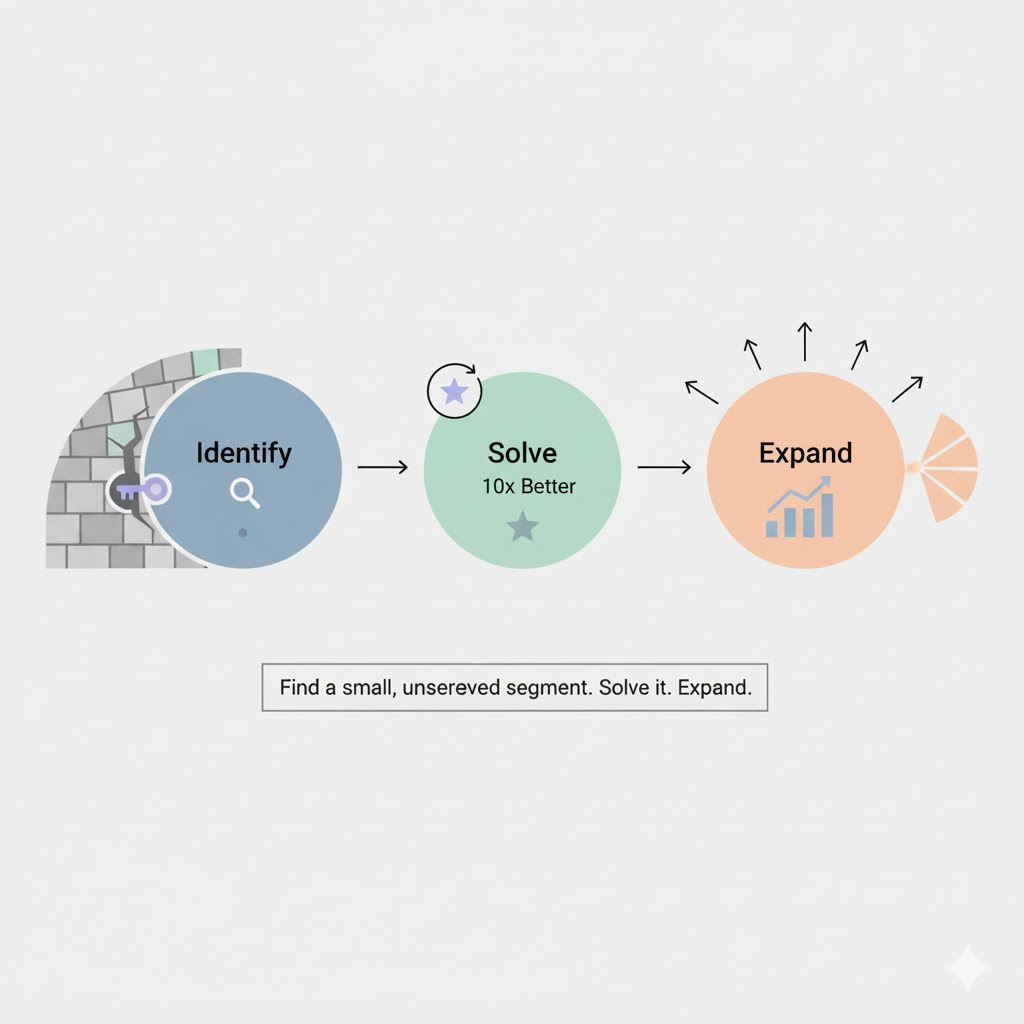
Every big company starts small. Your wedge into the market is what makes you defensible: it’s the first stronghold you use to expand later.
Without a wedge, you are just another competitor in a crowded market struggling for revenue.
Framework: The Beachhead Wedge
Identify → Find a small, underserved segment with a pressing problem.
Solve → Deliver a solution better than current alternatives in at least one clear way that prospects are crying out for.
Expand → Use that success as a launchpad to adjacent segments or broader markets.
Classic problems
Trying to win everyone on day 1.
Launching a copycat product with no clear differentiation.
Scaling before you’ve nailed one niche.
Risks of not fixing
You drown in crowded markets with no differentiation.
No one remembers your brand because you’re generic.
Competitors outmaneuver or copy your product before you’ve gained traction.
Actionable playbook (do this week)
Identify 1 prospect niche (e.g., remote-first law firms, vegan meal prep influencers, micro-SaaS founders - go deep).
Validate demand: run 5–10 calls or interviews with this niche to uncover pain points and willingness to pay.
Build a landing page or MVP tailored to that persona.
Test signups with $100 in targeted ads or outreach.
Collect metrics: interest, clicks, signups, and feedback. Use this to refine USP and expand strategy.
Steal this prompt:

Act as a senior growth strategist for early-stage startups. My startup operates in [industry/niche], and I want to identify a niche segment where our product/service can deliver a 10x improvement over existing solutions. Please provide:

1. Beachhead persona – a detailed, high-potential target segment with clear pain points and motivations.

2. Unique Selling Proposition (USP) – a compelling message or value proposition that resonates strongly with this persona.

3. Step-by-step pilot plan – a low-budget validation strategy using [budget amount, e.g., $100] for targeted ads, outreach, or experiments.

Include:
Specific actions to take
Expected costs and timelines
Metrics to track success

Additionally, suggest any overlooked angles or creative approaches to reach this persona and validate demand efficiently.
These companies figured it out:
B2B case study
Perplexity AI (2023) Instead of competing with ChatGPT head-on, Perplexity carved a wedge as the “answer engine.” Their beachhead persona? People frustrated with Google clutter. By focusing tightly on this niche, they earned traction, built a differentiated product, and grew a loyal base before taking on larger competitors.
B2C case study
Notion initially targeted knowledge workers and productivity geeks who were dissatisfied with existing note-taking tools. By building a product that solved their exact pain points (flexibility and modularity) they created evangelists. These users became a marketing engine through shared templates and community engagement, giving Notion a strong launchpad to expand to a broader audience of students, teams, and enterprises.
More B2B tips
Target a single vertical or persona segment where value is obvious and measurable.
Use a land-and-expand strategy within accounts: start small, then upsell or cross-sell once trust is established.
Build case studies or references from early wins to expand into adjacent verticals.
Measure early CAC vs. LTV in the niche before expanding to other segments.
More B2C tips
Focus on early adopters or super-fans in a niche community.
Leverage viral content or referral loops to wedge into larger audiences.
Encourage word-of-mouth through shareable experiences or incentives (exclusive features, rewards, gamified elements).Monitor engagement metrics (shares, comments, repeat use) as your wedge signal.
TL;DR
Intuition and AI tools got you a functional product. At this point, vibes stop. Now you need a structured plan to build a growth motor.
So:
Figure out your startup’s current growth stage using our checklist.
Reverse-engineer goals: what revenue do you need and when, then work backwards to establish your plan.
Now work forward: get customer insights and sense check your plan from point 2
Budget and be scrappy. Follow point 6 and this rule becomes easier.
Be brave enough to use guerrilla tactics. Failing that, small low-cost experiments.
Get your foot in the door with a niche audience and best-in-class solution to their burning problem. Expand from there.
…And by layering AI as your growth copilot using our playbook promptly library, you’ll rapidly turn gut feeling into traction.
Kate Busby is CoFounder of Quiet Edge and a Fractional CMO based in Barcelona, Spain, catch her on X and Instagram. The images are extracted from X and created by MidJourney. No names and identifying details have been changed. Subscribe to Substack to receive all articles in the “Rules of Growth” series straight to your inbox.
🤝 Want to work together? ⏩ Check out the options and let me know how we can join forces.