

Chapter 6 — Pricing Without Losing Your Mind
If you’ve made it this far, congratulations — you’ve built something, talked to real customers, and started to learn how to sell. Now comes the part that makes even experienced founders sweat: deciding how much to charge for it.
Pricing feels uncomfortable because it sits at the intersection of logic and emotion. You can build your product with spreadsheets and frameworks, but when it’s time to talk about money, something inside you might freeze. And that’s normal. It’s not just about numbers — it’s about value, confidence, and fear.
Why Pricing Feels So Hard
When you’re early-stage, you don’t have benchmarks, reference points, or data. You’re not sure what’s “fair.” You’re terrified of charging too much and losing the deal — but you’re equally afraid of charging too little and looking cheap.
Underneath it all is a quiet imposter voice whispering:
“Who am I to ask for that much?”
That’s the wrong question. The right question is:
“What is this worth to the person buying it?”
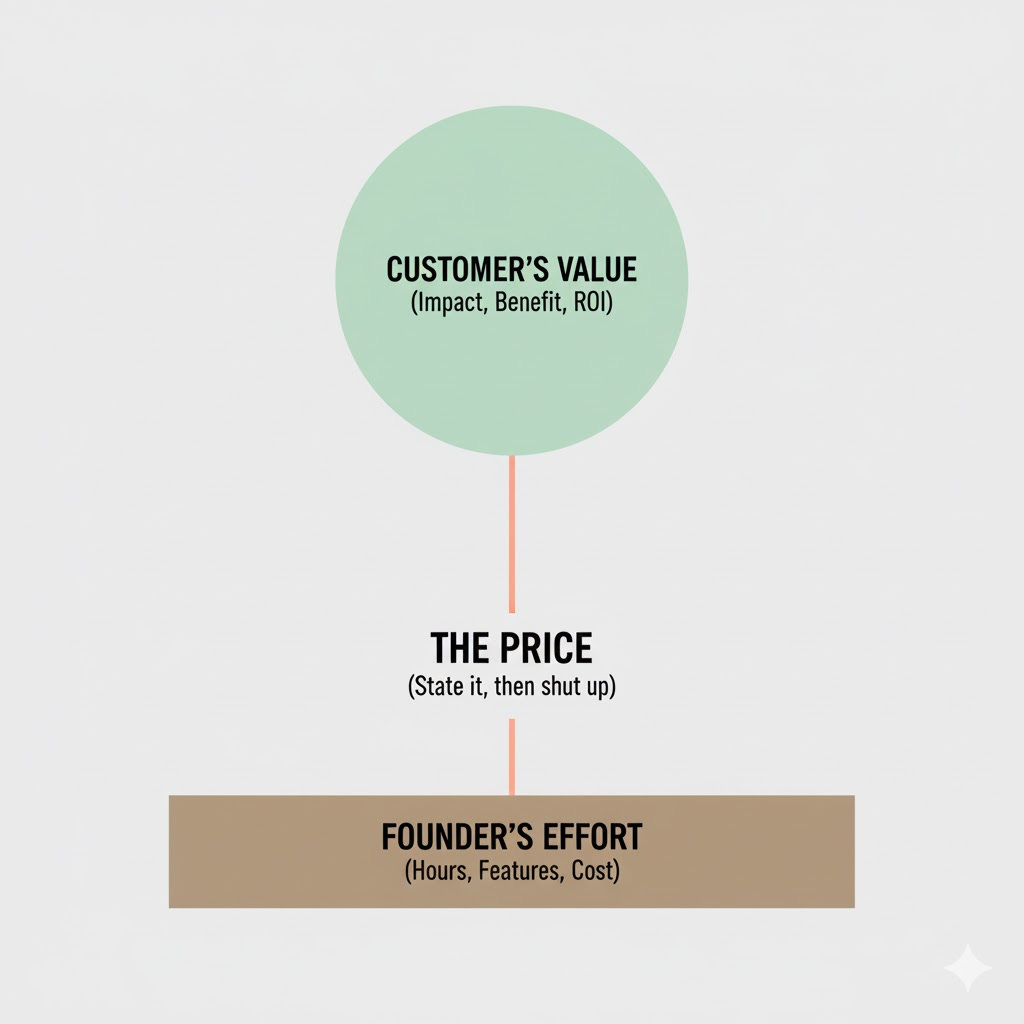
Your price isn’t a reflection of your self-worth. It’s a reflection of the impact your product creates.
💡 Takeaway: Price the value you deliver, not the hours you’ve spent.
The Three Pillars of Early Pricing
In the beginning, your pricing won’t be perfect — and it doesn’t need to be. What matters is that it’s anchored in logic, tested in reality, and communicated with confidence.
Here’s a simple framework to think about early pricing:
Comparables: What do your customers currently pay to solve this problem (even if it’s with a bad solution)?
Impact: How much money, time, or pain do you help them save or gain?
Positioning: Where do you want to sit in the market — the cheaper, faster option or the premium, more capable one?
Those three inputs give you a range. Within that range, your job is to pick a number and test it — not to find the mythical “perfect price.”
💡 Takeaway: Early pricing is a hypothesis, not a verdict.
Start Simple
When you’re early, your goal isn’t to optimize revenue. It’s to learn what customers are willing to pay and why. That means your first pricing model should be simple enough to explain in one sentence. If you can’t describe it clearly, it’s too complicated.
Avoid the temptation to offer 10 pricing tiers or endless “enterprise” customizations. Those will come later. Right now, you just need to answer one question:
“Can I charge money for this — and can I do it again?”
💡 Takeaway: A confusing price is worse than a low one.
The Fear of Asking
Let’s address the elephant in the room: saying your price out loud.
You’ll know you’re about to do it when your heart rate doubles and your voice gets slightly higher. It’s fine. It happens to everyone the first few times.
Here’s the trick: say your price calmly, then stop talking. Don’t justify it. Don’t start discounting mid-sentence. Don’t explain your cost structure or your roadmap. State it, then wait.
That pause after you say the number will feel eternal. Resist the urge to fill it. If the other person is interested, they’ll respond. If they hesitate, that’s your chance to learn, not to panic.
💡 Takeaway: Say the price. Then shut up.
Discounts: The Startup Drug
Discounts are like caffeine. One cup sharpens your focus; five cups make you anxious and jittery.
A small discount to get your first few customers on board is fine. But if you start using discounts as your default tactic, you’re signaling that your price — and your confidence — are negotiable.
Every time you discount, you’re training your market to expect it. And the customers you attract that way are often the least loyal ones.
Instead of cutting price, focus on adding value. If someone says, “That’s too expensive,” respond with:
“Help me understand what you’re comparing it to.”
That question will tell you whether you have a pricing problem or a communication problem. Usually, it’s the latter.
💡 Takeaway: Discounts solve anxiety, not objections.
When to Charge Less (and When to Say No)
There are times when it makes sense to lower your price — but only if you’re getting something valuable in return. For example:
A pilot project that gives you public results or testimonials.
An early adopter willing to act as a design partner.
A customer in a strategic vertical you want to understand.
In those cases, you’re not discounting — you’re trading value. Just make sure that trade is explicit and limited in time.
If someone simply wants your product cheap because “you’re new,” it’s okay to say no. Early customers set the tone for your brand. The wrong customer at the wrong price can slow you down more than losing the deal ever would.
💡 Takeaway: You can’t build a premium brand on bargain-basement habits.
Finding Your First Price
Here’s a practical way to set your first price without getting stuck in analysis paralysis:
Write down what you think your product is worth to a typical customer.
Cut that in half. That’s your comfort zone.
Double it. That’s your courage zone.
Start somewhere in between — then test both sides.
The truth will emerge quickly.
If everyone says “yes” instantly, you’re too cheap.
If everyone says “no” without discussion, you’re too high.
If you get a mix of reactions and a few customers ask thoughtful questions — congratulations, you’re probably in the right range.
💡 Takeaway: If nobody flinches at your price, it’s too low.
Price and Positioning Go Hand in Hand
Your price isn’t just a number — it’s a signal. It tells the world where to place you in their mental map.
If you’re significantly cheaper than everyone else, people will assume your product is simpler, riskier, or less capable — even if it’s not. If you’re much more expensive, they’ll expect a clear reason: exceptional results, white-glove service, or unique functionality.
The goal isn’t to undercut; it’s to align price with perception. If your product creates real value, your price should reflect that confidently.
💡 Takeaway: Cheap is a strategy — just make sure it’s yours. In other words: if you’re going to compete on price, do it on purpose — not by accident or insecurity.
Communicating Value Simply
When discussing pricing, avoid jargon like “ROI” or “synergy.” Instead, talk in human terms:
“You’ll save 10 hours a week.”
“You’ll reduce failed transactions by 30%.”
“You’ll onboard new users in half the time.”
People understand time and results. They don’t care about “efficiency metrics.”
If you can link your price to a clear, specific outcome, it no longer feels arbitrary — it feels fair.
💡 Takeaway: The clearer the value, the calmer the pricing conversation.
When to Raise Prices
As you gain customers, confidence, and results, revisit your pricing regularly. If your product has improved, your reputation has grown, or your customers are getting significant value, it’s time to adjust.
Founders often wait too long to raise prices out of fear — fear of losing customers or breaking momentum. But underpricing is a silent killer. It eats your margins, your motivation, and your ability to invest in growth.
Raising prices doesn’t mean being reckless. It means aligning your price with the reality of your value.
💡 Takeaway: You can’t scale sustainably on yesterday’s pricing.
In Summary
Pricing is emotional before it’s rational. It’s as much about psychology as it is about math. Your goal isn’t to get it perfect — it’s to get it moving.
To recap:
Price for value, not effort.
Keep it simple and testable.
State your price with confidence — and silence.
Trade value, don’t give discounts.
Treat pricing as a living experiment.
You’ll know you’ve reached maturity in your pricing when you stop apologizing for it. When you can say, calmly and clearly, “This is what it costs,” and the prospect nods — even if they say no — you’ve crossed an invisible line.
Because pricing, at its core, is just a reflection of one thing: belief in your own value.
💡 Final Takeaway: Your price tells the world how seriously to take you. So set it like you mean it.
Massimiliano Pani is a Sales and Customer Success expert and Founding Member of Quiet Edge, based in Mallorca, Spain. With nearly a decade of experience spanning the full sales spectrum—from business development to enterprise sales—he now focuses on helping technical founders navigate their first sales motions. Follow him on LinkedIn.