

Chapter 7 — Record Everything (Because You’ll Forget Everything)
If you’ve been following along, you’ve done a lot already. You’ve talked to potential customers, tested your story, adjusted your pricing, and survived the early emotional rollercoaster of selling.
Now you’re learning at a pace you probably haven’t experienced since you started building the product. And that’s great — except for one problem: you’re going to forget most of it.
Not because you’re careless, but because founder-led sales are messy and fast. You’re switching between conversations, product decisions, investor meetings, and delivery. In the middle of that chaos, it’s easy to lose track of the small but critical insights that will later define your go-to-market strategy.
That’s why this chapter is about one simple rule: record everything.
The Founder’s Memory Trap
When founders start selling, they often make the same mistake: they trust their memory. They think, “I’ll remember what that customer said,” or “That was a great objection, I’ll note it later.” And then — they don’t.
The next time they face a similar conversation, they repeat the same mistake, ask the same question, and miss the same signals.
Your brain is built for creativity, not documentation. But in sales, forgetting is expensive. Every insight you fail to capture today is an obstacle you’ll have to rediscover tomorrow.
💡 Takeaway: Your conversations are data. Treat them like assets.
Why Recording Matters
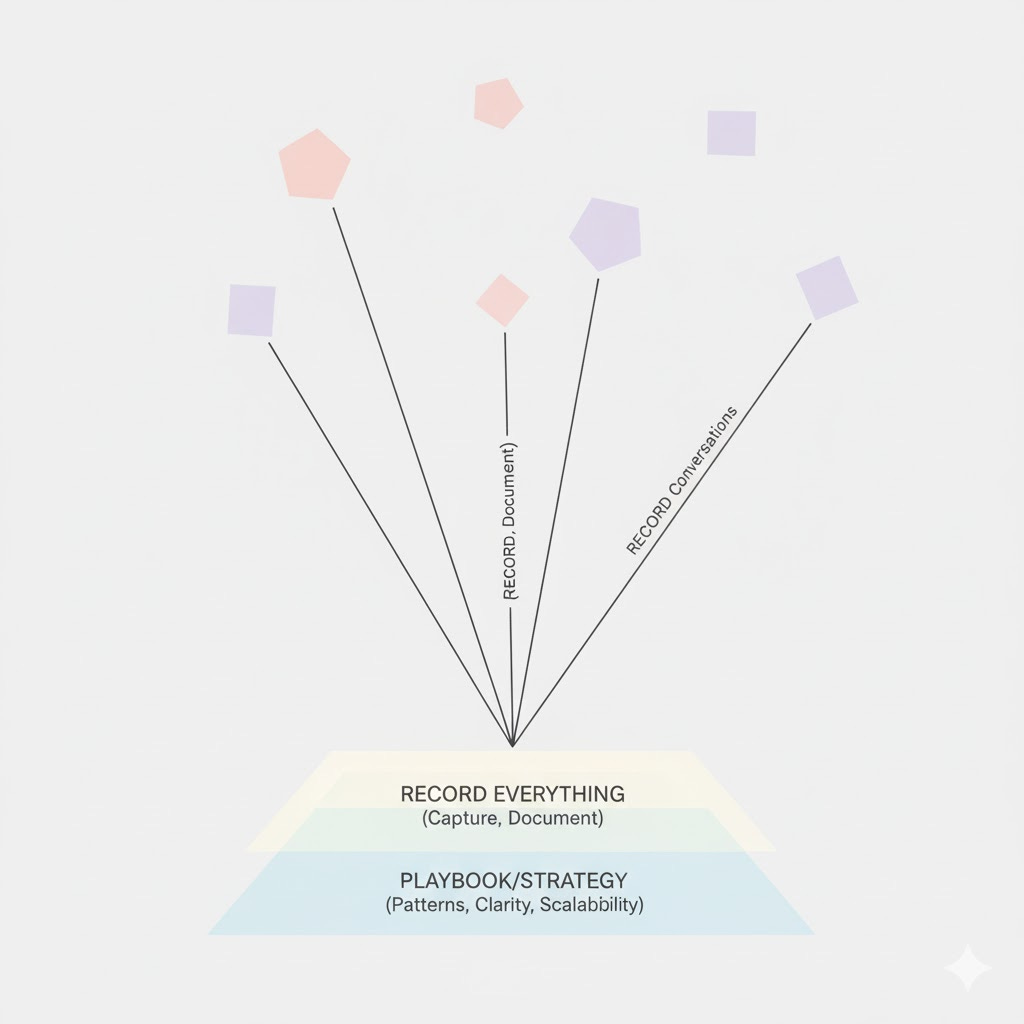
Documenting what you learn is not busywork — it’s the foundation of repeatability. It’s how you turn random wins into a playbook, and how you prepare your future team to succeed without guessing.
Here’s what systematic note-taking gives you:
Patterns: You start seeing recurring objections, interests, and buyer types.
Clarity: You understand which messages resonate and which confuse.
Proof: You can back your instincts with evidence when discussing strategy.
Scalability: You create material that will later help you onboard your first salesperson or marketing hire.
In short, recording your process turns your personal learning curve into a company asset.
💡 Takeaway: Good notes are the bridge between founder-led sales and scalable growth.
What to Capture
You don’t even need a CRM to get started. In fact, keeping it lightweight will help you actually do it. Start by tracking these essentials for every conversation:
Who you spoke to: Name, company, role, and how you found them.
Their problem: In their own words, what’s painful or inefficient.
Their current solution: What they’re doing today to cope.
Their reaction: What caught their attention, confused them, or made them skeptical.
Next steps: What you agreed to do — and by when.
Optionally, add:
Objections: What they hesitated about and how you responded.
Keywords: Phrases they used to describe the problem (these are gold for future messaging).
Deal status: Even a simple “Active / Waiting / Lost” helps spot trends later.
You can keep this in a spreadsheet, a Notion page, or even a Google Doc. The tool doesn’t matter — the habit does.
💡 Takeaway: Don’t aim for perfection. Aim for consistency.
How to Take Notes Without Breaking the Flow
Taking notes during a call can feel awkward at first. You might worry it looks unprofessional or distracting. Here’s the secret: most people appreciate it. It shows you’re paying attention.
Just let them know:
“I might take a few notes while we talk so I don’t miss anything important.”
Then write down phrases, not paragraphs. Focus on what’s emotionally charged — things they emphasize, repeat, or complain about. Those moments reveal what truly matters.
After the call, spend five minutes adding context: what you learned, what surprised you, and what you want to test next.
💡 Takeaway: The five minutes after a call are worth more than the call itself.
Building a Simple Learning Loop
Once you have notes from a few dozen conversations, patterns will start emerging. That’s when things get interesting.
Here’s a simple weekly ritual to turn your notes into insight:
Review: Read through your notes once a week.
Tag: Highlight recurring themes — repeated objections, similar outcomes, phrases customers use.
Summarize: Write a short reflection: “This week I learned that X matters more than Y.”
Adjust: Change something in your next round of conversations — your pitch, your pricing, or your targeting — and test it.
Over time, this process will create a living document of your startup’s evolution. You’ll literally see how your understanding of the market matures.
💡 Takeaway: Learning compounds only if you capture it.
Tools That Make It Easier
You don’t need enterprise software to stay organized.
Start small with what you already use:
Spreadsheets: Simple, flexible, and fast to update.
Notion: Great for combining notes, tasks, and reflections.
Granola: It records all the conversation for you and extracts a summary.
Later, as your pipeline grows, you can migrate this data into a CRM like HubSpot, or Salesforce. But for now, the goal is to build a habit, not a system.
💡 Takeaway: Tools don’t build discipline. You do.
The Story Hidden in Your Data
As your notes accumulate, you’ll begin to see the bigger picture emerge. Patterns will appear that no single conversation could reveal:
Which customer profiles close faster.
Which objections disappear when you frame the problem differently.
Which channels consistently bring warmer leads.
Which words trigger interest — and which trigger resistance.
This is when founder-led sales stops feeling like guesswork. You’re not just reacting anymore — you’re learning deliberately.
And that’s the moment your go-to-market strategy starts to take shape organically.
💡 Takeaway: Every data point is a clue. Collect enough, and the map appears.
Preparing for Your Future Sales Hire
Everything you’re documenting now will eventually make someone else’s job easier — and save you months of onboarding pain.
When you finally bring in your first salesperson or business developer, you’ll have:
A record of what your best conversations looked like.
A list of tested objections and effective responses.
Clear examples of customer language.
A pricing history and rationale.
That’s not just documentation — that’s your first sales playbook.
Most startups skip this part and wonder why their first sales hire struggles. They’re missing the raw material that turns “founder intuition” into a teachable process.
💡 Takeaway: Your notes today are your future team’s training manual.
Common Mistakes to Avoid
A few traps to watch out for as you start recording your sales process:
Over-documenting: Don’t turn it into a novel. Keep it simple and actionable.
Ignoring context: Numbers matter, but so does tone. Capture how people said things.
Losing discipline: One missed entry becomes two, then ten. Keep the habit alive.
Treating notes as archives: Review them often — they’re tools for learning, not storage.
💡 Takeaway: The best notes are the ones you actually use.
In Summary
Recording everything might sound tedious, but it’s what separates guesswork from insight. This is how you turn random founder experience into structured company knowledge — and how you prepare to scale without losing the lessons of your early hustle.
To recap:
Write things down — always.
Capture patterns, language, and emotions, not just facts.
Review regularly and refine your approach.
Use simple tools until complexity becomes necessary.
Treat your notes as the foundation of your playbook.
You’ll thank yourself later. Because when your future sales hire asks,
“How do our best customers usually describe their problem?”
you won’t have to guess — you’ll have the answer right there, in your own words and theirs.
💡 Final Takeaway: Documentation turns intuition into strategy.
Massimiliano Pani is a Sales and Customer Success expert and Founding Member of Quiet Edge, based in Mallorca, Spain. With nearly a decade of experience spanning the full sales spectrum—from business development to enterprise sales—he now focuses on helping technical founders navigate their first sales motions. Follow him on LinkedIn.