

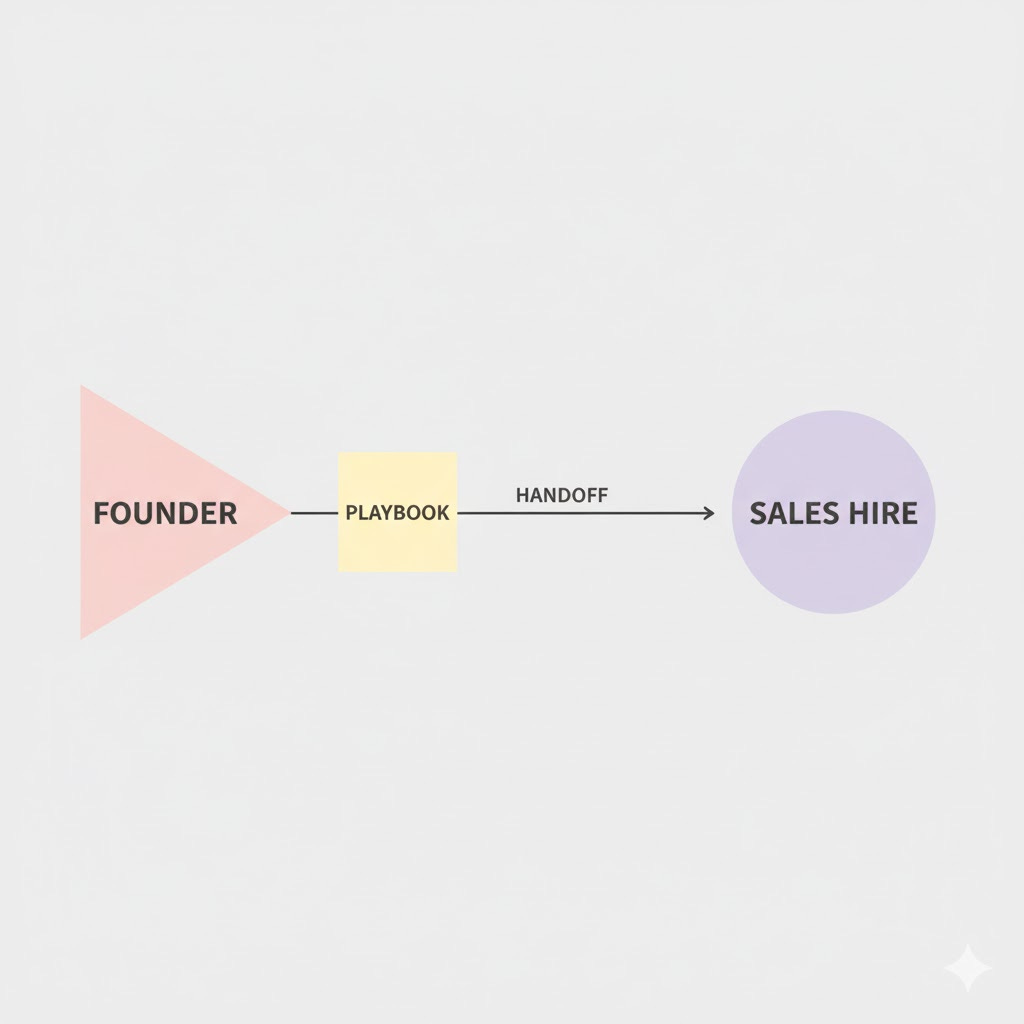
Chapter 8 — When to Let Go: From Founder-Led to First Sales Hire
If you’ve made it to this chapter, take a moment to appreciate how far you’ve come. You started as a technical founder who wasn’t sure how to sell. You’ve talked to real customers, refined your story, learned to listen, priced your product, and even built a small system to capture what you’ve learned.
Now, you might be wondering: How long do I have to keep doing this myself? When is it finally time to hire someone to take over sales?
It’s a good question — and an important one. Hire too soon, and you’ll waste precious time and money. Wait too long, and you’ll burn out doing a job you’re not supposed to do forever.
The trick is knowing when you’ve done enough to make sales teachable.
Why You Can’t Hire Yet (Probably)
Let’s start with the hard truth: most founders try to hire a salesperson far too early.
They think, “I’ll bring in someone who’s good at this so I can focus on the product again.” But if you haven’t already proven that your product can sell — at least in some repeatable way — you’re not hiring a salesperson, you’re hiring a translator for a language you don’t yet speak.
No salesperson, no matter how talented, can succeed in that situation. They’ll walk into uncertainty and guesswork, and when things don’t click, you’ll both end up frustrated.
💡 Takeaway: You can’t outsource what you haven’t understood.
The Three Signs You’re Ready
So when are you ready? Look for these three early indicators — they’re not perfect, but they’re surprisingly reliable.
1. You’re Hearing the Same Things Over and Over
Your customers are starting to sound familiar. The objections, the motivations, the triggers — they repeat. This means your market is starting to show patterns, and your message is resonating consistently enough that someone else could learn it.
2. You Can Describe Your Buyer Clearly
You no longer say, “It depends.” You can name your ideal customer profile with confidence — who they are, what they care about, and what drives them to act.
3. You Have a Documented Process
You’ve written down how you find leads, what your discovery calls look like, how you demo, how you follow up, and what pricing works. It doesn’t have to be pretty — it just has to be repeatable and actionable.
When those three signs align, congratulations: you’re ready to teach someone else how to do what you’ve been doing manually.
💡 Takeaway: You’re ready to hire when selling feels predictable — not chaotic.
The Wrong Reasons to Hire
Before you post that “Sales Lead” job, check your motivation.
Here are a few wrong reasons founders hire too early:
“I hate selling.” (Understandable, but not fixable through delegation.)
“We need to scale fast.” (Scale what, exactly? Unproven assumptions?)
“Investors expect us to have a sales team.” (Investors expect results — not org charts.)
Hiring out of discomfort or pressure usually leads to bad fits. You’ll either hire someone too senior who expects structure you don’t have, or someone too junior who needs structure you can’t yet provide.
💡 Takeaway: Never hire a salesperson to solve an emotional problem.
The Right Kind of First Sales Hire
When the time is right, the kind of person you hire matters more than their title. Your first sales hire isn’t just a “closer.” They’re a builder — someone comfortable with ambiguity, testing hypotheses, and iterating fast.
Here’s what to look for:
Curiosity: They ask “why” more than they pitch.
Adaptability: They can handle the messiness of a product still evolving.
Ownership: They take initiative and don’t wait for perfect processes.
Feedback orientation: They enjoy being part of shaping the go-to-market, not just executing it.
Avoid people who need rigid systems or are used to selling from polished brand recognition. Early sales are raw and improvisational — you need someone who can thrive in that.
💡 Takeaway: Your first sales hire should be an explorer, not a bureaucrat.
How to Prepare Before Hiring
Before you hand over the keys, do your future self (and your future salesperson) a favor: organize your knowledge.
Here’s what you should have ready:
Your sales narrative — the story that consistently works.
A short customer profile — who to target, what problems they face, what words they use.
A lightweight playbook — steps for outreach, discovery, demo, and follow-up.
Examples of past calls or emails — real conversations that worked.
Pricing logic — why you charge what you do and what’s negotiable.
It doesn’t have to be a polished manual. It just needs to be enough for someone new to learn from your experience instead of starting from zero.
💡 Takeaway: Don’t hand off sales. Hand over understanding.
Avoiding the Founder Dropout Syndrome
When you hire your first salesperson, resist the temptation to vanish into product mode. You might think, “Finally, someone else can handle this.” Not yet. Your job shifts, but it doesn’t disappear.
You move from doing the selling to coaching the selling. Sit in on early calls. Review notes. Listen to recordings. Share insights. The goal isn’t to micromanage — it’s to transfer context.
Too many founders disappear after hiring their first rep, only to reappear months later asking why revenue hasn’t grown. Usually, it’s because they never finished the handoff.
💡 Takeaway: Hiring a salesperson doesn’t mean you stop selling. It means you start leading sales!
How to Know the Handoff Worked
You’ll know your transition from founder-led to scalable sales has succeeded when three things happen:
Deals close without you.
The first time a deal closes and you weren’t in the meeting — that’s the signal you’ve created a repeatable process.Language consistency.
Your salesperson uses the same story, phrases, and positioning you developed — and it works.Predictable metrics.
You can look at the pipeline and roughly predict outcomes. No more wild swings or mystery deals.
That’s the moment you can finally take a breath. You’ve gone from improvisation to orchestration.
💡 Takeaway: You’ve succeeded when your absence doesn’t break the process.
What You’ll Still Need to Do
Even after you’ve hired your first salesperson, your job isn’t done. You’ll still be:
Refining the product based on new feedback.
Supporting key or strategic deals.
Strengthening relationships with your earliest customers.
Maintaining the culture of listening and learning that got you here.
Your role just shifts from frontline to foundation.
💡 Takeaway: The founder’s sales job never truly ends — it just evolves.
In Summary
Knowing when to let go is one of the hardest transitions in the founder’s journey. It’s not about ego; it’s about readiness.
To recap:
Don’t hire until you’ve found repeatability.
Look for patterns, not perfection.
Hire for curiosity and adaptability, not polish.
Hand over a system, not chaos.
Stay involved until success repeats without you.
When that happens, you’ve officially graduated from “founder who sells” to “founder who built a company that sells.” And that’s one of the clearest signs of real traction.
💡 Final Takeaway: Letting go doesn’t mean stepping back — it means creating space for growth.
Massimiliano Pani is a Sales and Customer Success expert and Founding Member of Quiet Edge, based in Mallorca, Spain. With nearly a decade of experience spanning the full sales spectrum—from business development to enterprise sales—he now focuses on helping technical founders navigate their first sales motions. Follow him on LinkedIn.