


Start with why
Design Founders, you have dreamt up a product idea, whispered it into an LLM, and just like that, it’s live. You’re officially a vibe coder. Now it’s time to get paid.
“Rules of Growth” ask the six most important questions to land your first customers on a lean budget without burning yourself (or your future team) out.
As you test, what are you looking for? This: one repeatable, scalable go-to-market motion that will drive your growth for the next 3-6 months.
Pause: don’t fall into the trap of vibing your way to an expensive marketing fuck up i.e. a product that does not sell. I do not want this for you.
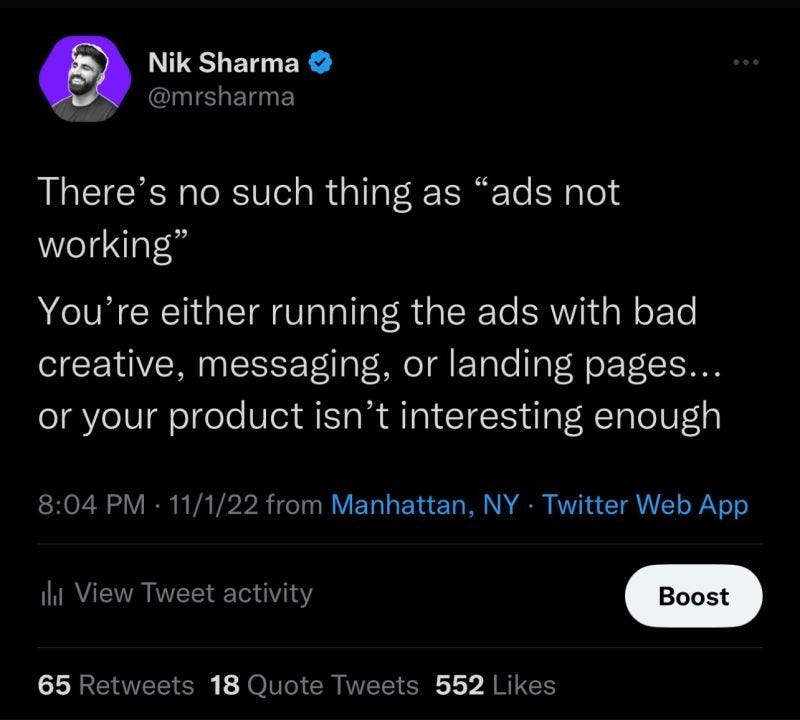
Be warned: competition is intensifying. You will always discover new competitors as time passes. Vibe coding and AI in general are flooding the market with new products.
And when building is this cheap and easy, only founders who master the rules of growth will quickly reach their first revenue milestone.
I’m Kate, Fractional CMO for edtech startups, and whenever I begin a role, I use these six questions to challenge myself and the teams I’m supporting. They are a compilation of the best lessons I’ve learned from my mentors and hands-on experience.
Time for six big reveals. Vamos →
The Six Questions:
1. Where are we in the growth journey today?
2. If we reverse-engineer from (i) revenue goal to (ii) reach required, what would the funnel be?
3. If we work forward from (i) customer insights to (ii) revenue goal, what are we required to do?
4. How can we make our $1 budget work like $10?
5. What scrappy growth moves feel authentic to our company?
6. Let’s zoom in and execute: who is our beachhead persona and our wedge?
Big reveal Number #1:
1. Where are we in the growth journey today?
Too many companies mistake a handful of paying users for proof of demand. They pour money into ads only to slam into a wall when growth stalls.
Before chasing scale, get honest about where your product really is. Early users aren’t validation. True validation comes from repeatable revenue and clear product–market fit.
Let’s figure out where your vibe-coded startup is right now.
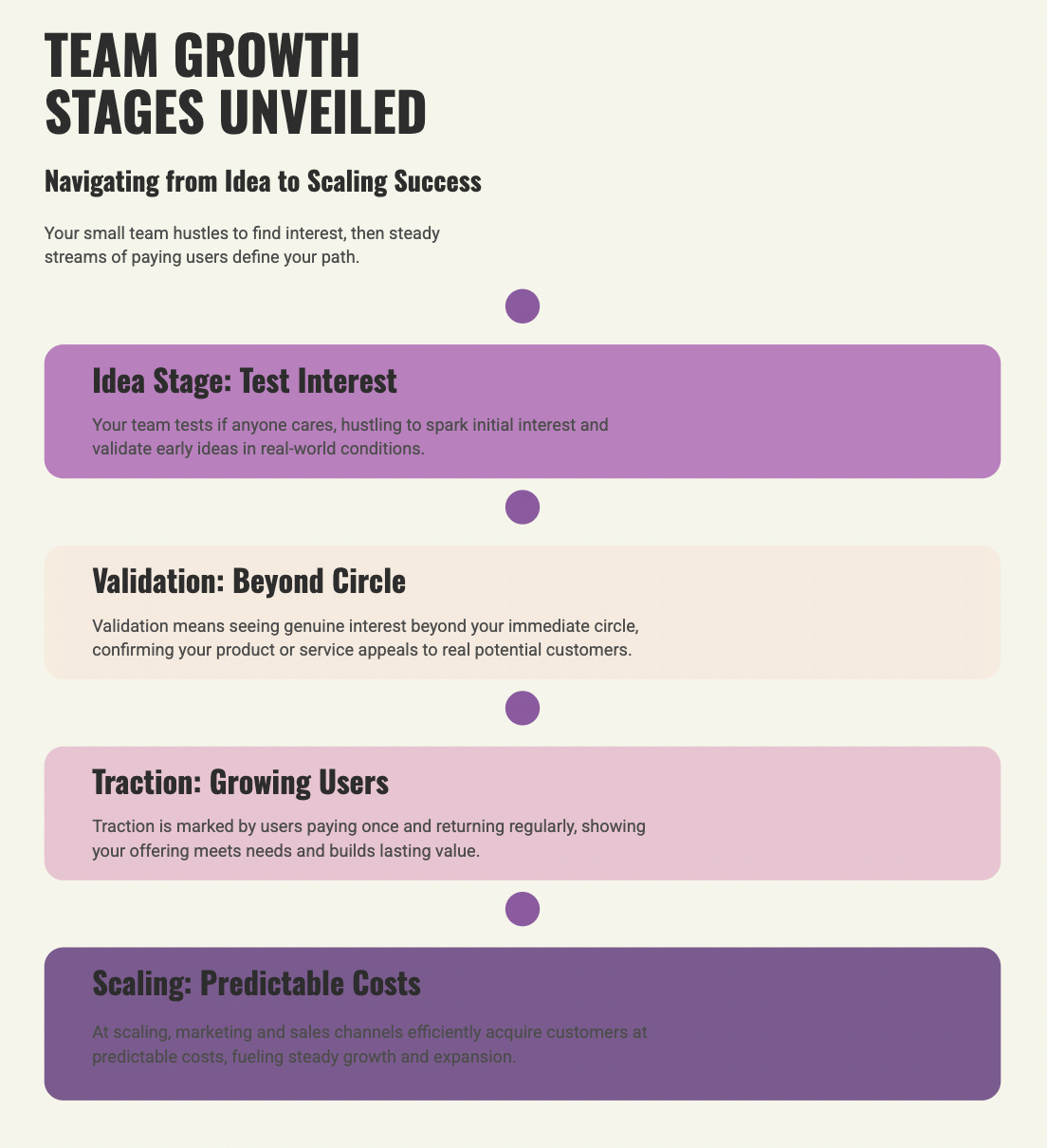
Four main growth stages
Idea → You / your tiny team is hustling to see if anyone cares.
Validation → Hustle ends. There is a steady stream of interest beyond “friends, family, fools.”
Traction → Some users are paying once. Others are paying again and again. This latter group should be growing month by month, not dying off.
Scaling → Marketing and Sales channels are now working to reach a key milestone without inflating costs, which could be:
the thing we built is now self-sustainable (Break Even)
the thing we built is making money (Profitability)
the thing we built is really taking off (Scaling)
Let’s go deeper:
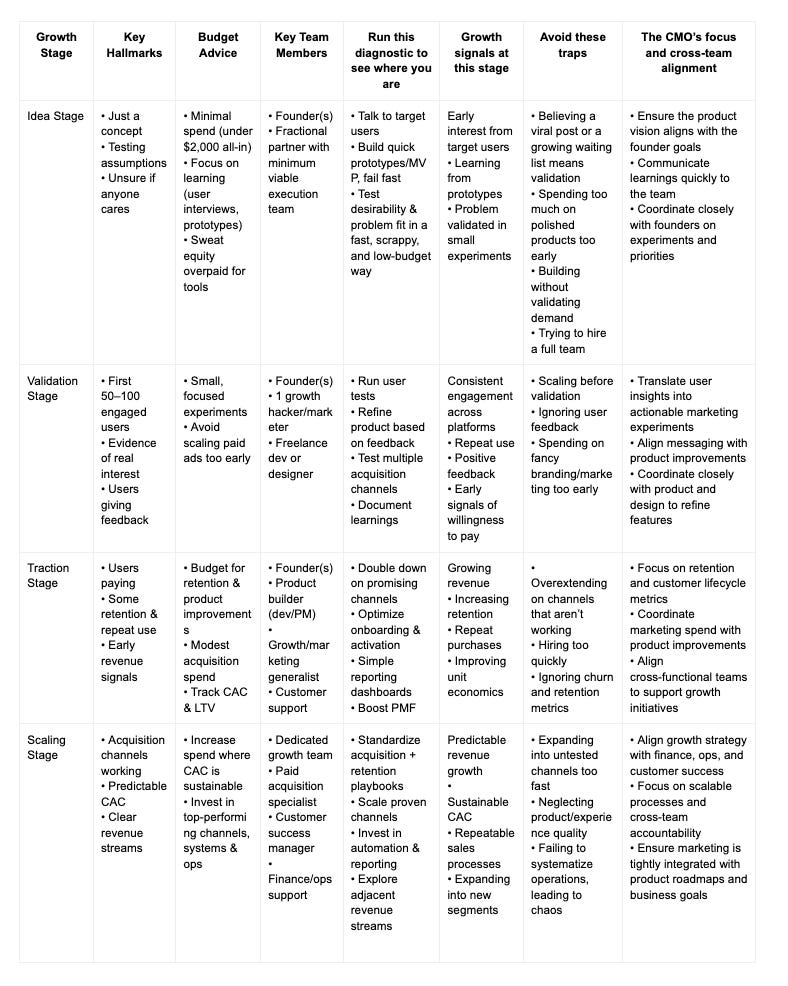
Use this table as a reference.
Now you’ve got the theory, let’s move to action.
Actionable playbook (do this week)
Open a doc → create 4 columns: Idea, Validation, Traction, Scaling.

Using the diagnostic tips in the table above, write down where you feel you sit today. It’s completely normal if you find yourself spanning two stages.
Now, feed the list into ChatGPT with this prompt:“Based only on the signals in this list (and not on any assumptions beyond it), what’s the single most important growth priority I should focus on?”Tip 👉 Adding ‘based only on the signals in this list’ helps the model stick to the provided inputs instead of pulling in outside guesses.
These companies already figured it out:
B2B case study
Butter started as a tiny remote startup focused on one specific thing: a specialized virtual workshop platform for facilitators of interactive trainings and live collaborative sessions who were deeply frustrated with Zoom.
Although the company had raised about $440,000 through grants, venture debt and equity from Morph Capital, they did not rush into broad promotion. Instead, Butter’s founders spent their early months speaking 1:1 with meeting facilitators to understand whether problems like “Zoom fatigue” were big enough to represent a real opportunity. They consistently heard that facilitators needed more cohesive and human experiences than Zoom could offer. This feedback shaped Butter’s positioning as “laser focused on workshops” with “delightful design” that “supports facilitators in delivering a more human experience.” (Source: TechCrunch.)
Early adopters led to growing traction (both organic and paid) because the problem was widespread, underserved by competitors and the numbers of facilitators was large enough to get scale.
By April 2021, the company raised a $2.75 million seed round (later extended to $3.2M) led by Project A and several angel investors. And in 2024, Butter announced that it was joining powerhouse Miro, bringing its facilitation expertise and workflows into Miro’s broader visual collaboration ecosystem, sealing their growth. (Source: Butter blog.)
B2C case study
Gamma secured seed funding in 2021 and launched its public beta in 2022, but its real breakthrough came not from new investor money, but from zeroing in on an unsolved problem for a specific, high-potential audience. While tools like PowerPoint and Notion were built for people who already knew what they wanted to say, Gamma noticed a growing wave of professionals struggling with the blank page problem: the paralysis of starting a presentation from scratch. This segment, knowledge workers who needed to communicate ideas quickly but lacked time, design skills, or structure was huge, underserved, and hungry for help.
By embedding AI capabilities in early 2023, Gamma became the first presentation platform to generate a ready-to-edit draft from a single prompt, a never-seen before approach, turning “blank page” friction into an instant starting point. (Source: JPMorgan Chase) The result was a user-activation breakthrough: within nine months, Gamma grew to around 10 million users. Retention rose sharply as those same users kept returning to refine and share AI-generated decks, and monetization followed organically.
By 2025, Gamma had scaled to 50 million users and $50 million in ARR with a team of just 30 people, remaining profitable from early 2024 onward. Its growth was powered almost entirely by product-led adoption, word-of-mouth, and a crystal-clear focus on a single, underserved audience rather than broad marketing spend.
When Gamma raised its $12 million Series A in May 2024 (led by Accel), it wasn’t to chase growth — it was to sustain momentum already proven by a wedge audience whose unmet need had turned into a mainstream movement. (Source: FinSMEs)
How to Think About Growth Stages
Different types of AI-first startups grow at different speeds.
For example, an AI recruiter (B2B, long sales cycle) will grow very differently than an AI design tool (B2C, instant value).
That’s why it helps to map growth by vertical (industry), by who the buyer is, and by how mature your idea is.
B2B Growth Stages (selling to businesses)
When you know you’ve hit traction
You’ve reached Traction when you can track the full sales cycle (lead → conversation → closed deal) with enough consistency to forecast growth.
Key metrics to watch
MRR (Monthly Recurring Revenue):
The total predictable subscription revenue you generate each month.
How to calculate: Add up all active paying subscriptions for a given month.Churn:
The % of customers (or revenue) you lose each month.
How to calculate customer churn: (Customers lost ÷ Customers at start of month) × 100.
How to calculate revenue churn: (MRR lost ÷ MRR at start of month) × 100.Qualified Leads:
Leads that actually match your buyer profile and show intent (not just a random signup).
⚠️ Warning: If new accounts are coming in but many are canceling quickly, you’re not really in traction yet — you’re still between the Idea and Validation stages.
B2C Growth Stages (selling to consumers)
Shorter cycles, different signals
For consumer products, raw revenue can spike early but that doesn’t mean you’ve found product-market fit. What matters is whether people keep using you and invite others in.
The “User-First” approach
Instead of fixating on DAUs (Daily Active Users) alone, focus on whether users can do the task they came for. Depending on your product, the right metric might be:
DAU / WAU / MAU → Daily, Weekly, or Monthly Active Users
Signup conversions → % of new users who actually start using the product
Task completions → e.g., number of documents created, rides booked, files shared
The idea: your early build cycles should obsess over helping users succeed at their core task, whatever that looks like.
Key metrics to watch
Retention: Do users come back after day 1, week 1, or month 1?
Referral loops: Do users invite others to join?
Virality signals: Social shares, reshares, content engagement.
Community adoption
Momentum often starts in small groups. If one cohort of users adopts you and spreads the word to another, you’re moving from Validation into Traction.
Five more big reveals in “Rules of Growth” series:
2. If we reverse-engineer from (i) revenue goal to (ii) reach required, what would the funnel be?
3. If we work forward from (i) customer insights to (ii) revenue goal, what are we required to do?
4. How can we make our $1 budget work like $10?
5. What scrappy growth moves feel authentic to our company?
6. Let’s zoom in and execute: who is our beachhead persona and our wedge?
Kate Busby is CoFounder of Quiet Edge and a Fractional CMO based in Barcelona, Spain, catch her on X and Instagram. The images are extracted from X and created by MidJourney. No names and identifying details have been changed. Subscribe to Substack to receive all articles in the “Rules of Growth” series straight to your inbox.
Regarding the topic of the article, your emphasis on moving beyond 'vibe coding' to a structured growth strategy is increadibly important for new AI startups, echoing the deep insights I've come to expect from your writing.