


The Conversation That Wouldn’t Leave Me Alone
A few weeks ago, I had coffee with one of the best marketers I know.
She’s experienced, strategic, and genuinely good at her job. But as we talked, something shifted in her voice. She’d been applying for roles. The “secure” positions, the ones at companies everyone recognized , were disappearing. Not slowly. At scale.
“I just don’t know if I’m keeping up,” she said.
That sentence stayed with me.
Not because she was wrong to feel it. But because she was exactly the kind of person who shouldn’t have to.
As we kept talking, something else came into focus. The specific tasks she was struggling to use AI for weren’t abstract. They were the core of the job:
segmenting a market properly
writing a clear brief
developing an integrated campaign
making a defensible investment decision in a channel or audience.
In other words, the fuzzy, complex, judgment-heavy work that doesn’t reduce neatly to a prompt.
And I recognized that immediately. Because I’ve spent years watching marketing teams from the inside.
Here’s what most people outside marketing don’t see: the function looks simple from a distance and is genuinely hard up close. A successful campaign isn’t one person’s work. It’s hours of data gathering, customer research, stakeholder alignment, channel management, performance analysis, and fast decisions made under pressure , most of which is invisible by the time anything goes live.
What I’ve noticed over the years is that teams who’ve brought AI into that work, even imperfectly, even just using Claude or ChatGPT for research and drafting, move differently.
They process more. They spend less time on consolidation and more time on thinking. They show up to meetings having already done the analysis.
The teams still doing it manually aren’t less capable. They’re just burning the same hours on work that doesn’t require their best thinking.
And here’s the part that doesn’t get said enough: in most organizations, marketing is already on thin ice.
Marketing is one of the few functions where your perceived value depends heavily on whether leadership believes in it.
If the CEO sees marketing as a strategic driver, you’re resourced and respected. If they see it as a necessary cost (unpredictable, hard to measure, always asking for budget) marketing leaders get short tenures and back-breaking expectations. That’s nothing new.
What is new is what happens when those skeptical leaders look at a McKinsey report saying 50 to 70 percent of marketing tasks can be automated. That number isn’t going down.
The conclusion some leaders will reach isn’t “let’s upskill the marketing team.” It’s “let’s reduce the headcount and automate the rest.” Not because they’re right, but because the argument is now easy to make.
That’s the real threat. Not AI itself. The threat is AI becoming the justification for decisions that were already waiting to be made.
Which means the marketers who stay in the game, who get hired, who build roles, who make themselves indispensable, won’t be the ones who avoided AI. They’ll be the ones who got ahead of it.
Look at what’s happening in engineering. Some of the roles most exposed to AI disruption are still being filled at FAANG companies and beyond. But the candidates getting those offers aren’t the ones who ignored the tools. They’re AI-powered practitioners who use the technology confidently and bring judgment the model can’t replicate.
Fewer roles, higher barrier to entry, different skills.
Marketing is heading the same direction. My bet is that the marketers who come out of this transition well aren’t the ones who waited to see what happened. They’re the ones who made themselves AI-ready before it became a requirement.
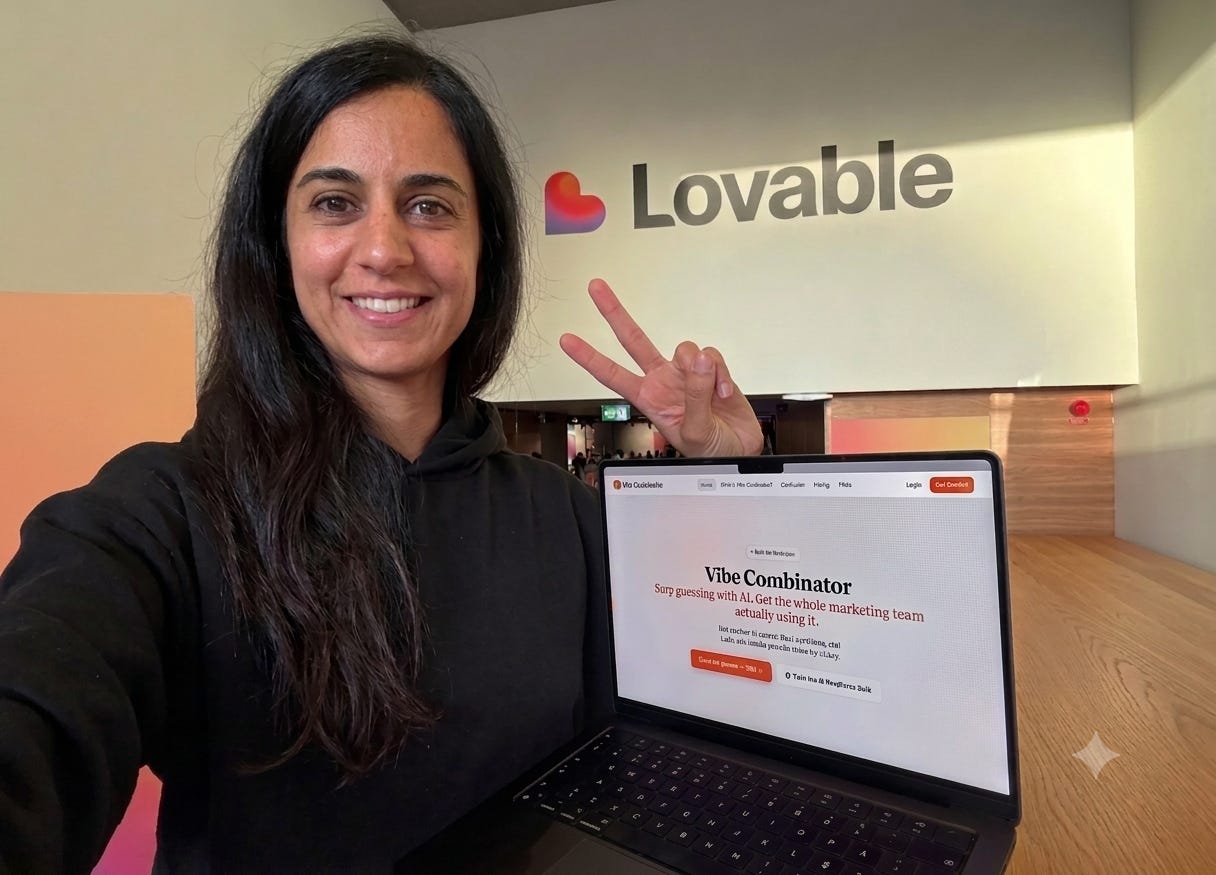
That’s what I was thinking about when I got accepted into the hackathon.
The Problem Wasn’t What I Expected
I ran a survey (you can take it here, too!) for marketers, business owners, consultants, and AI practitioners. Four questions.
I wanted to understand how people were learning AI and where they were getting stuck.
The responses revealed a clear pattern: interest in AI is high, but confidence and implementation are lagging behind.
Many respondents expressed concerns about falling behind peers, reduced earning potential, and eventual job displacement if they failed to improve their AI skills over the next 12–24 months.
What surprised me most was that learning resources were not the primary problem.
Participants were already learning through YouTube, LinkedIn, podcasts, webinars, online courses, bootcamps, communities, and daily experimentation with tools such as Claude and ChatGPT. The challenge was not access to information. The challenge was making sense of it all.
Several themes emerged repeatedly:
There is simply too much information.
AI is evolving faster than people can keep up with.
It is difficult to separate useful knowledge from hype and noise.
Many resources focus on generic AI skills rather than real marketing workflows.
Marketers struggle to find time to learn while managing their existing responsibilities.
One respondent summarized the challenge as wanting “templates, advice, and work that actually pertains to being a marketer, not just broad build-an-agent content.”
Another recurring theme was the desire for practical implementation rather than theory.
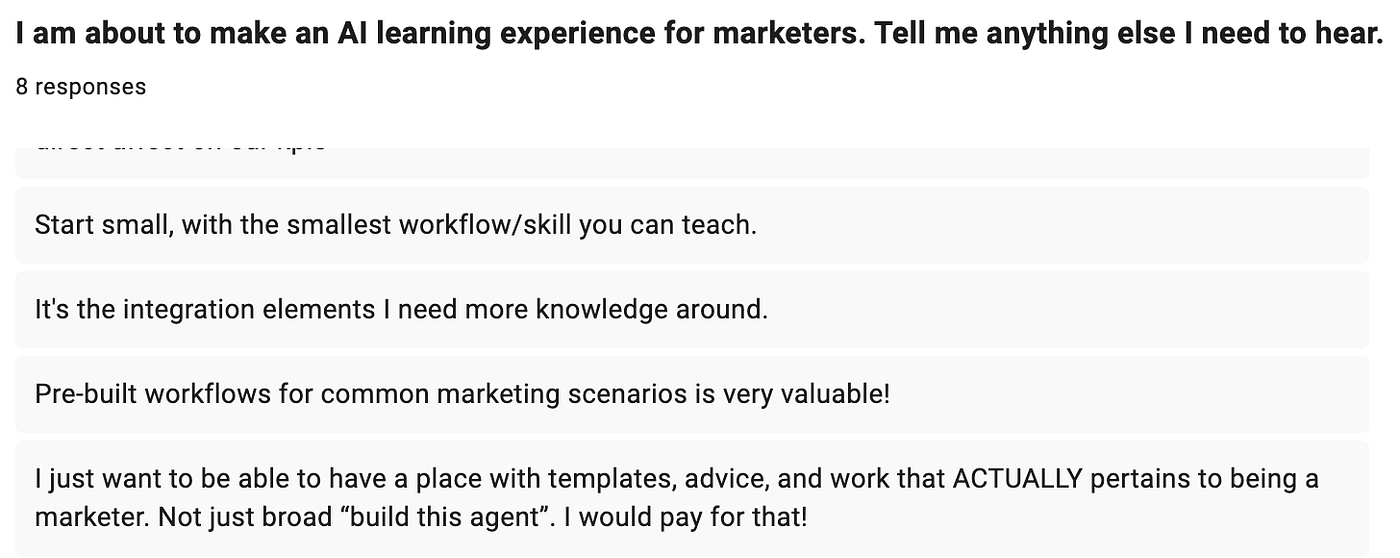
Anonymized answers from the survey
Respondents were less interested in learning how models work and more interested in understanding how AI could improve specific marketing outcomes.
They wanted help with research, content creation, campaign planning, reporting, analytics, customer insights, and doing their tasks more efficiently. They wanted workflows they could immediately apply to their jobs.
When asked what would make an AI learning experience worth paying for, respondents consistently favored:
Step-by-step marketing workflows.
Real-world marketing case studies.
Self-paced learning.
Live workshops.
Peer communities.
Career and job opportunities.
The survey also highlighted an important segmentation challenge. Not all marketers use AI in the same way.
An independent creator, agency owner, in-house marketer, and marketing leader often face very different constraints and opportunities. Some organizations actively encourage AI adoption, while others restrict tool usage because of governance concerns, or limit adoption to the “priority teams” (spoilers: marketing is not usually the priority team).
This means a one-size-fits-all AI curriculum is unlikely to be effective.
What I Actually Built
I stopped thinking about “just building another course.”
What the research pointed toward was something different: tools that solved a real problem first, and taught the underlying skill in the process.
So, the goal became creating practical, search-driven AI analyzers that capture existing search traffic, provide instant free value, all helping marketers solve real problems while simultaneously teaching them how AI can be integrated into their workflows.
And since I cannot stop at just doing something once, I build two of them.
These two micro products capture high-intent search traffic around practical AI use cases. Each one solves a specific marketing problem while introducing visitors to broader AI marketing workflows and capabilities that can be applied in their own business environments.
The two micro-products were:
AI Brief Converter, turning messy notes into a agency-grade brief in 10 seconds.
This analyzer is designed to capture existing search traffic, otherwise known as “inbound.”
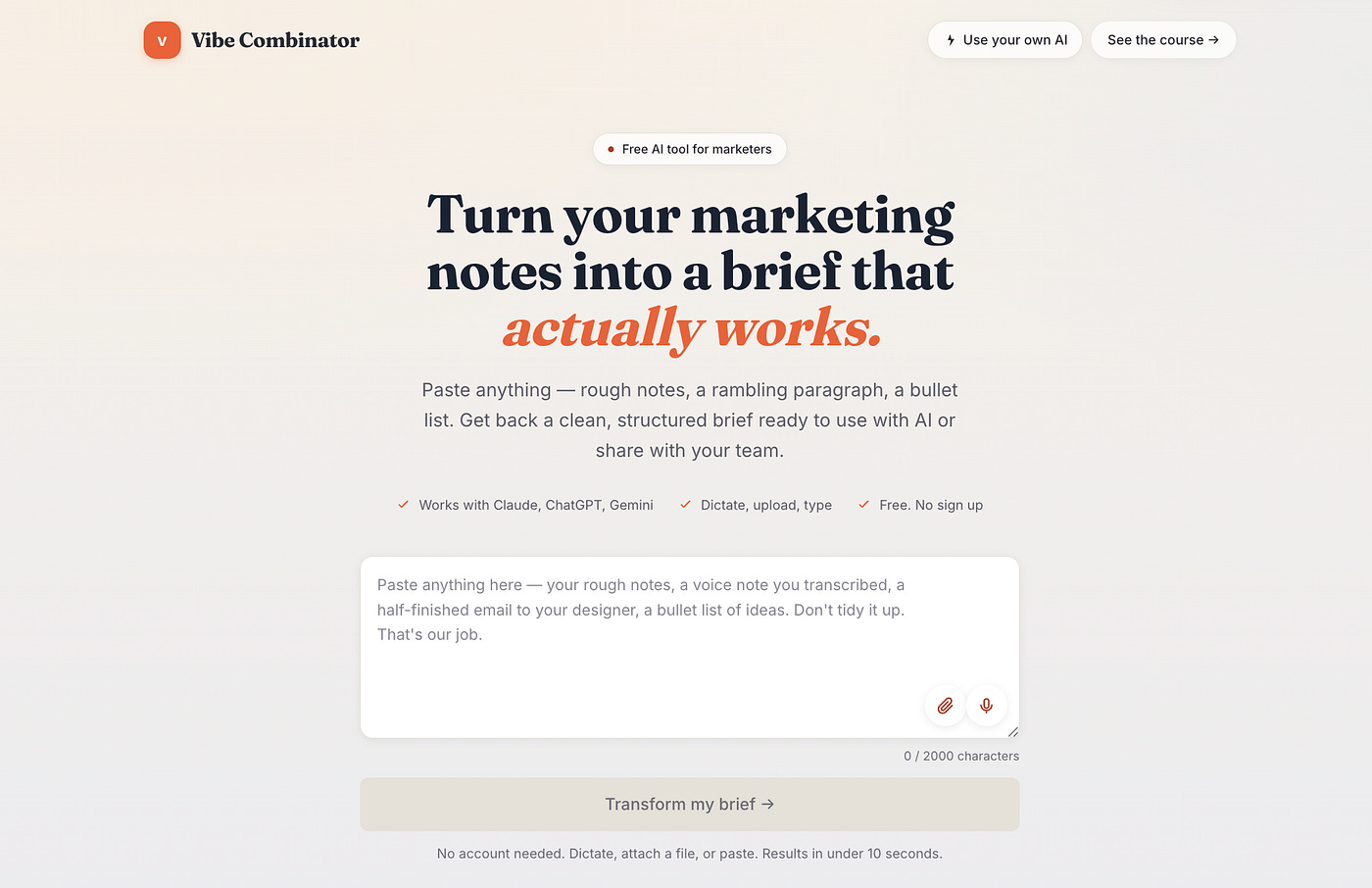
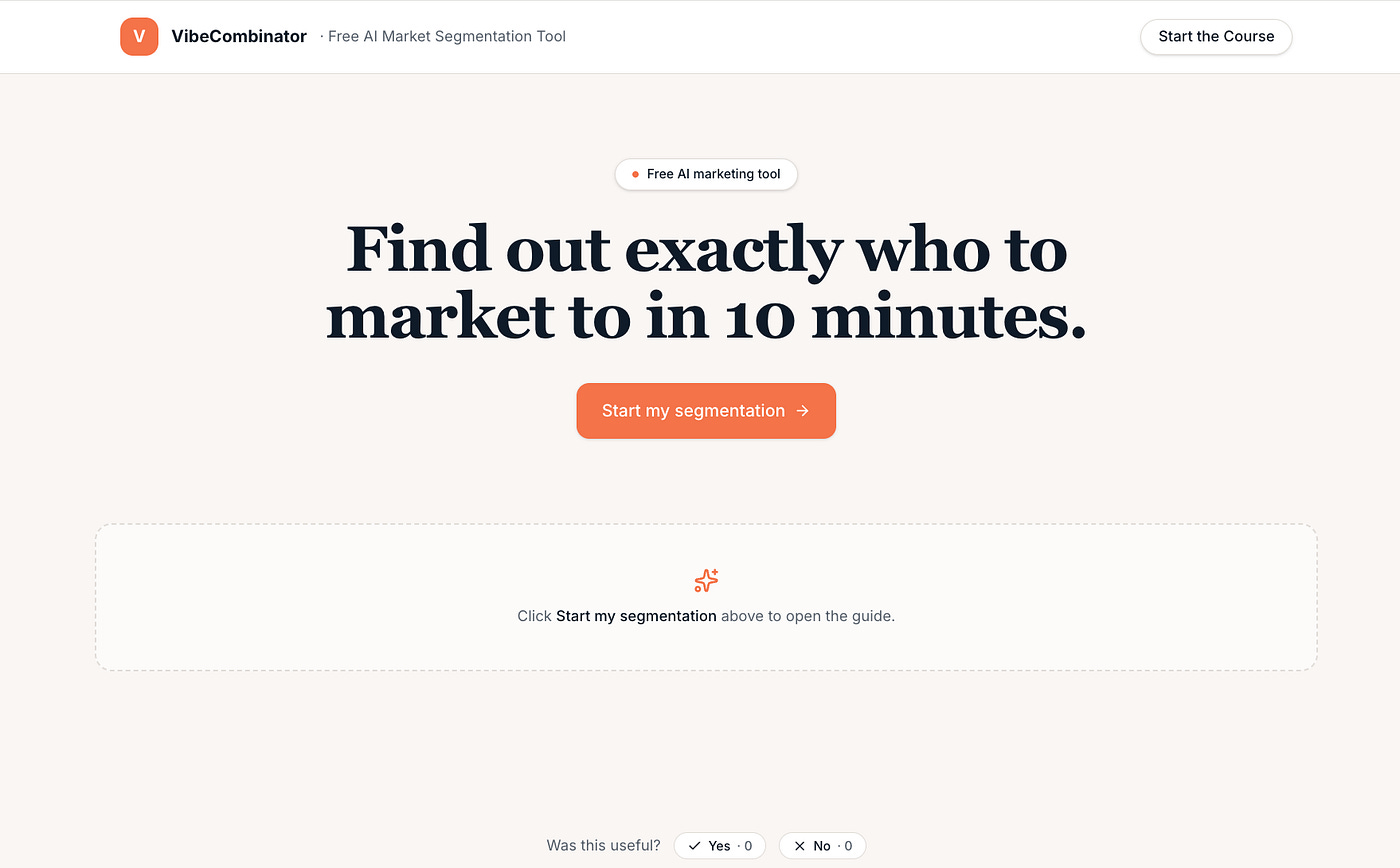
2. Market Segmentation Bot, helping marketers find out who to target by answering up to 12 questions.
This bot is designed to be a value offering as part of a cold outreach sequence, otherwise known as “outbound.”
I really wanted these products to push what AI intelligence can do.
Most AI marketing tools do this:
User → Prompt → AI generates personalized feedback.
The micro products do this:
User → AI diagnoses missing evidence → AI teaches what is missing → User gathers evidence → AI reassesses → AI produces strategy.
In short, I used AI to build a reasoning engine that closes knowledge gaps.
The AI behaves less like a content generator and more like a strategic partner that knows when it doesn't know enough.
It’s a use I see less often, and my bet is that it becomes more valuable, not less, as AI-generated content becomes 99% of whatever we see.
This is just the beginning. Either micro-product may fail to drive leads into the funnel. Either may fail to convert leads into paying learners. But the point is, I’ve built a couple of products to test, and I will learn from deploying them.
And again, why did I spend 48 hours building them and not begin with a full-blown AI course?
Because the central insight from the research was simple: marketers do not need more AI information. They need clearer paths to implementation.
What comes next
I decided not to stop at the micro-products.
Some folks will use them and end of story. It makes sense. But what about the people who do need more personalized support?
I began to think about whether these micro-products could segue into a learning experience. That’s where the “learning by building” paid course Vibe Combinator comes in.
The acqusition funnel is built as follows:
Discover a free AI-powered micro product through search.
Use the tool to solve a specific business or marketing problem.
Explore additional resources and AI workflows.
Choose a learning path.
Enroll in either a self-paced course or a 14-day intensive cohort-based program.
Access the full curriculum, templates, and community resources through the member portal.
Behind the scenes, Vibe Combinator combines deterministic application logic, curated educational content, and AI-powered experiences.
The free, public-facing tools provide immediate value to users, while the paid learning environment delivers structured training through self-paced and cohort-based courses.
This separation matters because the goal is not simply to generate AI outputs. Instead, the platform uses targeted tools to help users understand real business problems, experience practical AI applications firsthand, and then build the skills required to implement similar solutions within their own organizations.
System Architecture Map
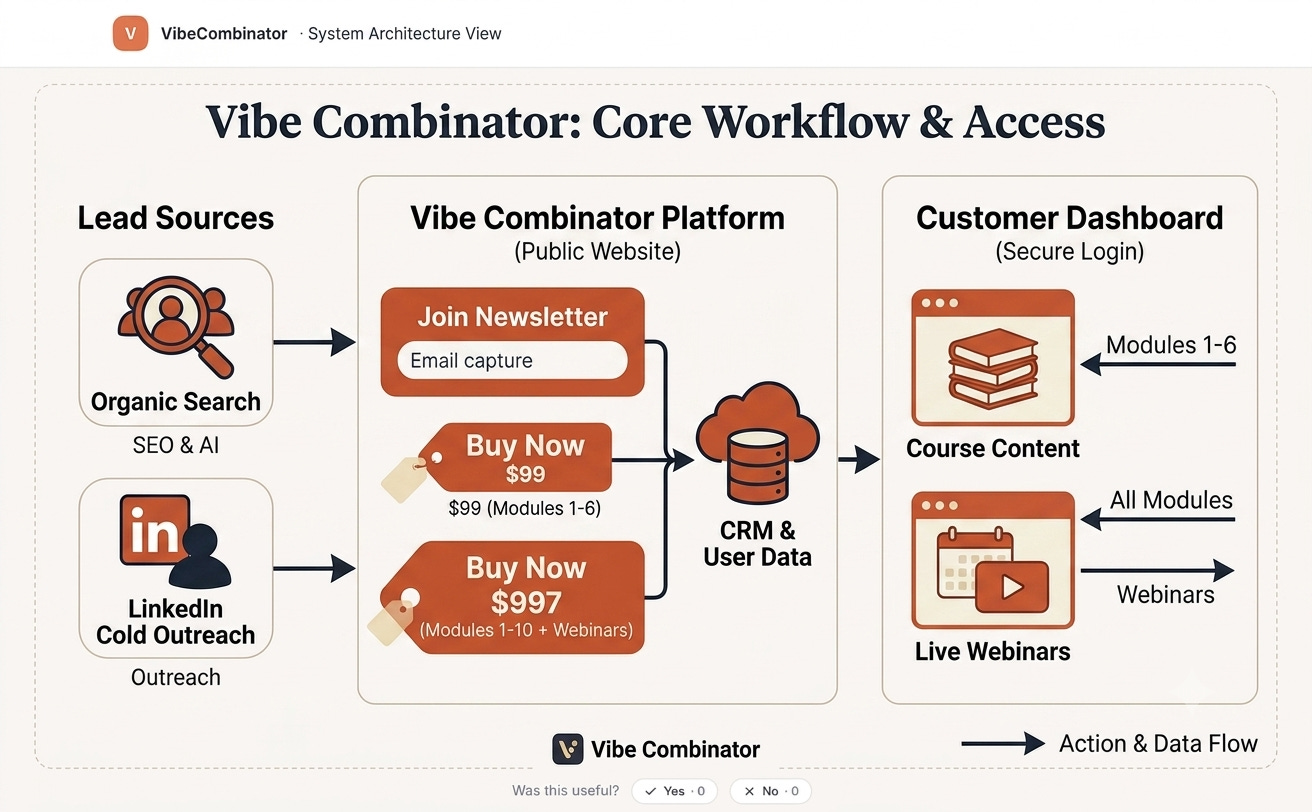
The system combines deterministic decomposition, signal extraction, explainable reasoning, evidence-based retrieval, and a full stack AI builder to generate practical, multi-step plans and summaries.
What I Learned Building It
Several lessons emerged from the project.
Machine learning and deterministic recommendation systems are both important components of AI, but I wanted to go beyond simply generating predictions or personalized recommendations. My goal was to close the gap between a user’s initial query and real-world implementation, following the signals garnered during the survey.
To achieve this, the AI takes an active role in guiding the process: asking the right questions, identifying gaps in the user’s understanding or data, and proposing practical steps to address them. The result is a blend of education and execution.
Rather than simply delivering answers, the system helps users develop the structured thinking required for rigorous market segmentation, so that through repeated interaction they gradually internalize the process themselves.
Another key learning: human feedback during the discovery and building process was essential.
Early testers and community feedback consistently highlighted what mattered most: explanations, editing capabilities, making complex concepts easier to understand and act on. This shaped Vibe Combinator’s direction toward clarity, usability and relevance.
Finally, the value of explainability over raw accuracy claims became clear. Users respond less to “what the system thinks” and more to “why this output makes sense to me,” based on their existing knowledge. Translating analysis into grounded, relatable reasoning increased trust and made outputs more usable in real workflows.
A further insight came from observing how structure reduced cognitive load. When the system proactively asked questions, breaking problems into consistent components (problem framing, key signals, interpretation, and next steps) users were able to engage more quickly and make decisions with less friction.
This reinforced the idea that the value is not just intelligence, but organization of intelligence.
Future Work
There are several clear next steps as I continue to build.
Adding a confidence score to the segmentations will act as a incentive mechanism for users to dig their heels in and continue their learning journey within the Market Segmentation Bot itself. You can use it as much as you want, it remains free forever.
And is this tool just for marketers? I doubt it.
There are more solo founders, consultants, indie makers, and AI builders than ever before. Part of the reason may be the enormous shifts in the white collar workforce, whether due to AI usage or an enduring post-pandemic correction.
And while most people can build something; far fewer know how to validate demand, identify a target customer, position their product, and acquire users efficiently.
Collaboration features could allow teams to co-create, review, and refine outputs together, especially in multi-stakeholder workflows. Explainability could also be expanded so users can see not just the final output, but the reasoning path, confidence signals, and supporting evidence behind each step.
Within the course itself, finding ways to create a distribution engine is important, too. For example, provided branded templates to help new users create social posts announcing their affiliation to the product.
Any real-world deployment would require careful attention to data governance, privacy, consent, auditability, and compliance with relevant regulations and institutional policies.
The current system remains a research and demonstration prototype built for experimentation and learning.
The Question I Keep Coming Back To
That marketer friend I mentioned in the beginning? She’s still searching for a job.
The uncertainty she described, that quiet fear of falling behind, isn’t unique to her. It’s running through an entire profession right now.
AI isn’t coming for marketers who know how to use it. It’s coming for the work that was always too slow, too repetitive, too draining, the admin that consumed hours better spent on strategy, creativity, and the kind of human judgment no model can replicate.
Vibe Combinator is one small attempt to close that gap. Two micro-tools, a learning platform still taking shape, and a lot still to test and learn.
But the question that started it, what would actually help her? feels like the right question to keep asking.
Because if the answer is a ten-second brief converter that makes one marketer feel less behind on a Tuesday morning, that’s not a small thing.
That’s exactly the point.
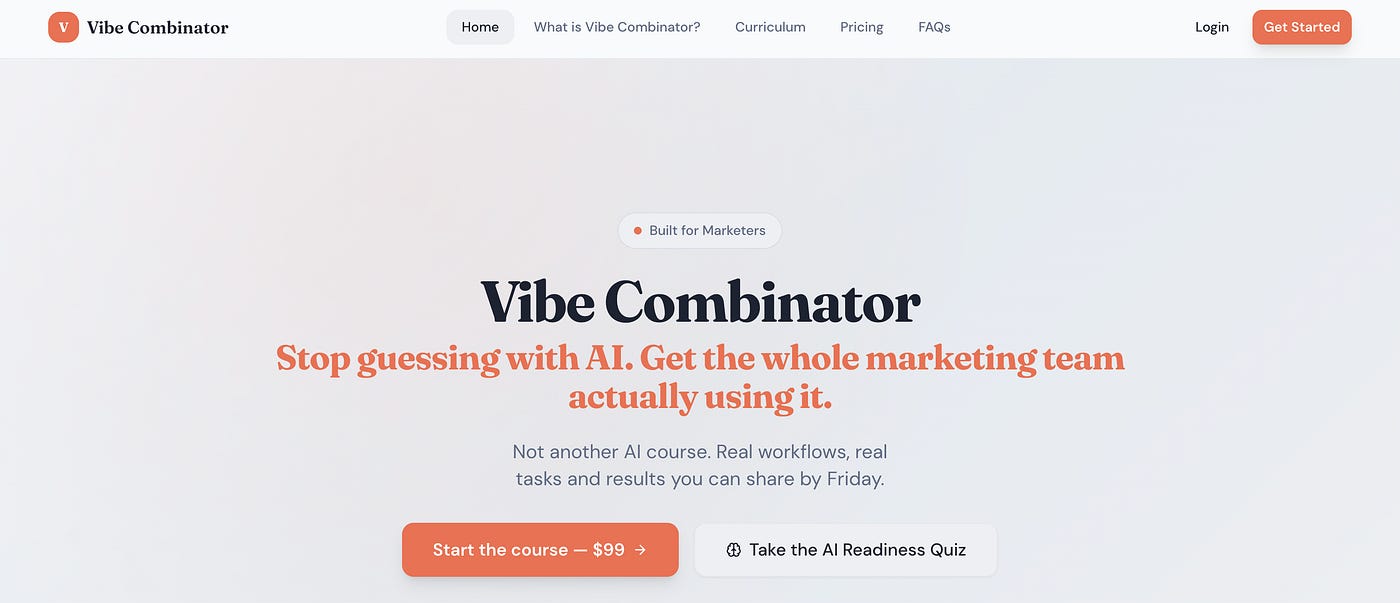
Vibe Combinator is live at vibe-combinator.lovable.app. The AI Brief Converter and Market Segmentation Bot are both free to use.
Links
Kate Builds in Public: https://kate-builds-live.lovable.app/
AI Brief Converter: https://ai-brief-converter.lovable.app/
Market Segmentation Bot: https://market-segmentation-bot.lovable.app/
Vibe Combinator · AI Skills for Marketers: https://vibe-combinator.lovable.app/
AI Usage Disclosure
Artificial intelligence tools were used during the preparation of this article to assist with grammar refinement, wording clarity, formatting, and editorial improvements.
All project design decisions, implementation details, evaluation methodology, analysis, human feedback, and conclusions were reviewed and verified by the author.