


Chapter 2 — The Evangelical Phase: Doing Things That Don’t Scale
If the first realisation is accepting that nobody will come just because you built it, this chapter is about what to do next — the part where you roll up your sleeves and start talking to the market one conversation at a time.
This is where most founders hesitate. You’ve already done the hard part (or so you think): you’ve built the product, maybe launched it, maybe even posted about it on LinkedIn. But customers aren’t appearing out of thin air, and suddenly, you’re faced with the task of selling — directly, manually, person by person.
It feels unscalable because it is. And that’s exactly what makes it valuable.
Why “Unscalable” Is the Right Strategy (For Now)
Early-stage sales are inherently inefficient. You’ll chase leads that go nowhere, run demos that don’t convert, and spend hours on conversations that don’t result in revenue. It will feel like you’re wasting time — but you’re not. You’re collecting the raw material that every future sales process will be built on.
This is what I call the evangelical phase: the period when you’re personally spreading the gospel of your product to people who don’t yet know they need it. You’re not scaling; you’re exploring. You’re identifying which parts of your story resonate and which ones fall flat. You’re listening for patterns, language, and emotions — the kind of insights that no spreadsheet can give you.
At this point, your most important KPI isn’t ARR. It’s learning velocity.
💡 Takeaway: If it feels unscalable, you’re probably doing it right.
The Founder’s Fieldwork
Think of this phase as your market’s equivalent of field research.
You’re not behind a dashboard looking at metrics — you’re out in the wild, talking to humans.
That means picking up the phone, scheduling calls, walking into offices, or sending cold emails that you write yourself. It’s slow and personal. But this is how you learn the nuances of your buyers’ reality — their workflow, their pain points, their motivations, and the language they actually use.
A few examples of what this might look like in practice:
Spending an afternoon with a potential customer just to understand how they currently solve the problem.
Offering to run a free or low-cost pilot in exchange for honest feedback.
Writing every follow-up manually because each conversation reveals new insight.
Keeping a personal spreadsheet of every interaction and what you learned.
This is the kind of work that would never make economic sense at scale — but it’s how every successful sales motion begins.
💡 Takeaway: Before you can automate anything, you have to understand it deeply.
The Trap of Imitating Big Companies
One of the most common mistakes founders make at this stage is trying to look “professional” too soon. They copy what established companies do — automated outreach, rigid funnels, metrics dashboards — and end up skipping the learning they actually need.
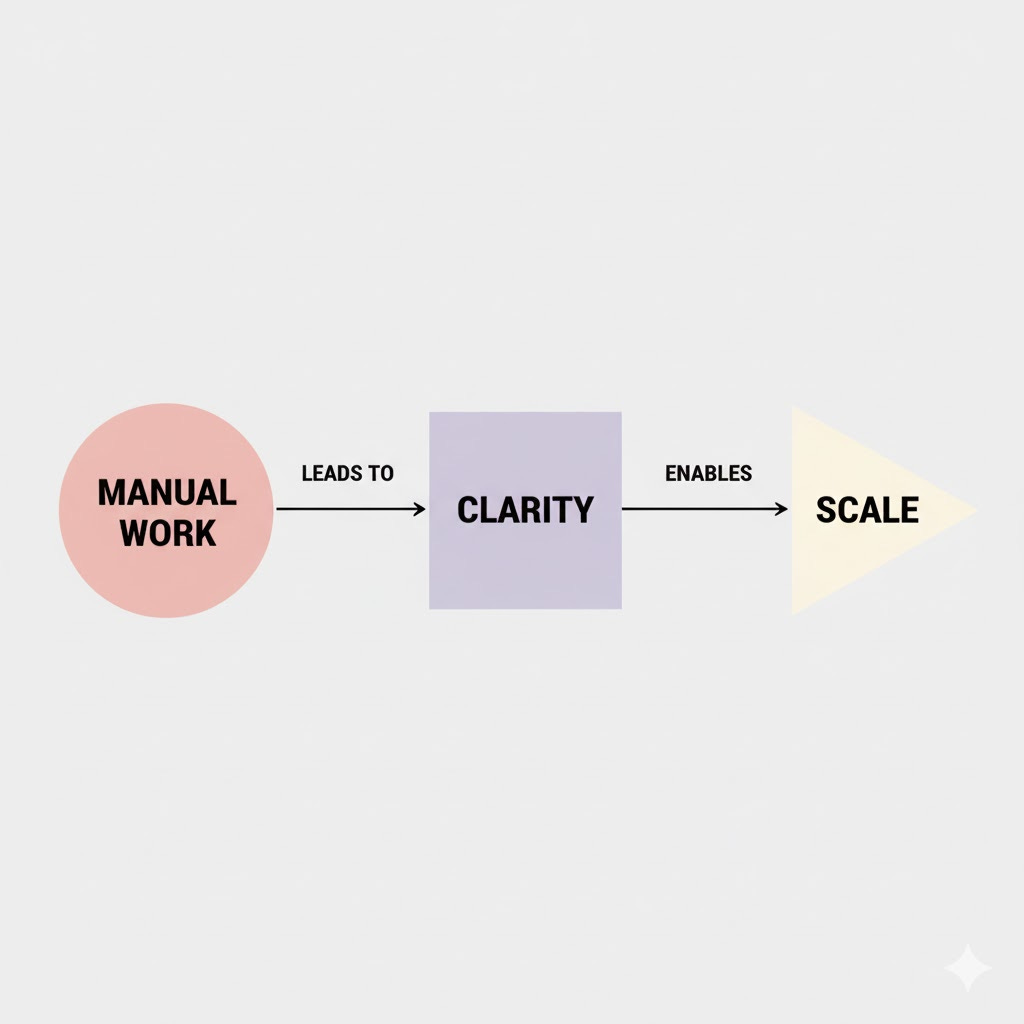
Here’s the problem: those big-company tactics work after you’ve figured out who you’re selling to and why. At this stage, you’re still in search mode, not execution mode. You don’t need scale; you need clarity.
So resist the urge to:
Build a complex CRM before you’ve closed your first handful of deals.
Hire an SDR to “fill your pipeline.”
Buy expensive marketing automation tools.
None of that will help until you’ve had enough real conversations to know what kind of leads you actually want.
Instead, keep it manual, messy, and personal. The unscalable things you do now will later become the foundation for the scalable processes that follow.
💡 Takeaway: Don’t copy mature companies. They’re optimizing for efficiency. You’re optimizing for discovery.
The Value of Proximity
In this phase, proximity to your customers is everything. The more direct your contact, the faster you’ll learn.
Go visit them. Sit in their office. Watch them use your product. See what confuses them, what excites them, what they ignore. These observations are worth far more than a polished survey or a product analytics report. They give you real-world context — the kind that helps you refine not only your sales pitch but also your roadmap and priorities.
When possible, do live demos instead of sending links. Don’t rely on a pitch deck to do the talking. Ask questions, take notes, and treat every interaction as a data point in your ongoing experiment.
Yes, it takes time. Yes, it feels inefficient. But there’s no faster path to understanding your customer than sitting next to them while they try to use what you’ve built.
💡 Takeaway: Real insight comes from proximity, not analytics.
Manual Work as an Investment
Many founders see unscalable work as wasted effort. In reality, it’s an investment — in knowledge, credibility, and relationships.
When you personally onboard a customer or build a custom workaround for them, you’re not just being “nice.” You’re creating a feedback loop that feeds directly into your product and positioning. You’re also signaling that you care enough to learn, which builds trust and advocacy.
Later, when your company scales, you’ll have playbooks for how to replicate these experiences through processes and people. But for now, you’re writing those playbooks yourself.
💡 Takeaway: Every unscalable action you take now writes the manual for your future team.
Balancing Passion and Discipline
During this phase, enthusiasm can be both your strength and your trap. It’s natural to be excited about your product — you’ve spent months or years building it. But too much enthusiasm can make you talk when you should be listening.
Customers don’t care how clever your code is or how advanced your algorithms are. They care about what your product does for them. That’s why your primary role now isn’t to pitch, but to listen deeply — to understand their pain better than they can describe it.
Approach each conversation like a journalist investigating a story: ask open questions, follow curiosity, and let silence do some of the work. Your goal is not to get them to say “yes.” It’s to uncover what would make them say “yes” — now or later.
💡 Takeaway: Passion opens doors; listening keeps them open.
Doing the Work Yourself
There’s no shortcut for this phase. If you try to outsource it, you’ll end up with filtered feedback — and filtered feedback is worse than none at all.
When you, as the founder, handle the first sales conversations, you hear the raw truth. You learn what customers really think — not what they tell an intermediary. You start noticing subtle cues, recurring words, and emotional triggers that will later shape your brand, your messaging, and your roadmap.
You’ll also develop empathy for the people you’re trying to serve, and that empathy will become a competitive advantage long after you’ve hired a sales team.
💡 Takeaway: Outsource tasks, not understanding.
Redefining Success During This Phase
It’s important to reset your expectations. You won’t be “closing deals” every week, and that’s fine. Success here isn’t measured in revenue — it’s measured in insight.
Ask yourself:
What did I learn about my market this week that I didn’t know before?
What messaging triggered interest, and what fell flat?
Which prospects leaned in, and why?
If you can consistently answer those questions, you’re progressing faster than you think. The goal isn’t volume — it’s clarity. You’re mapping the terrain before building the highway.
Over time, these small wins compound. You’ll start to recognize familiar patterns: the customer segments that get it right away, the ones that never will, and the conversations that consistently lead to next steps. That’s when you’ll know you’re ready to start thinking about scale.
💡 Takeaway: Progress at this stage is measured in clarity, not cash.
In Summary
The evangelical phase is not glamorous. It’s not efficient. It won’t look impressive on a slide deck. But it’s where real traction begins.
By doing things that don’t scale, you’re learning faster than your competitors. You’re building a deeper understanding of your market and forming the habits that will shape how your company grows.
And most importantly, you’re earning the right to scale later — because you’ll actually know what you’re scaling.
So embrace the mess. Take every call, follow every lead, and treat every conversation as a lesson. This isn’t busywork; it’s the groundwork for everything that comes next.
💡 Final Takeaway: You have to do the work that doesn’t scale before you can build the business that does.
Massimiliano Pani is a Sales and Customer Success expert and Founding Member of Quiet Edge, based in Mallorca, Spain. With nearly a decade of experience spanning the full sales spectrum—from business development to enterprise sales—he now focuses on helping technical founders navigate their first sales motions. Follow him on LinkedIn.
Hey, great read as always. Your emphasis on the unscalable, manual phase as critical for collecting foundational insights is extremely valuble. How do you suggest founders objectively measure the "raw material" quality during this initial exploration?