


I’m Kate, Fractional CMO for edtech startups, and whenever I begin a role, I use these six questions to challenge myself and the teams I’m supporting. They are a compilation of the best lessons I’ve learned from my mentors and hands-on experience.
Big reveal Number #3:
3. If we work forward from customer insights to revenue goal, what are we required to do?
Now flip the lens forward.
Once you know the reach, leads and purchases you need to hit your revenue goal, validate your assumptions with real customers.
Not once, not twice, but on an ongoing basis. Weekly, monthly, quarterly? It’s your call based on your resources and the pace of change in your industry.
Framework:
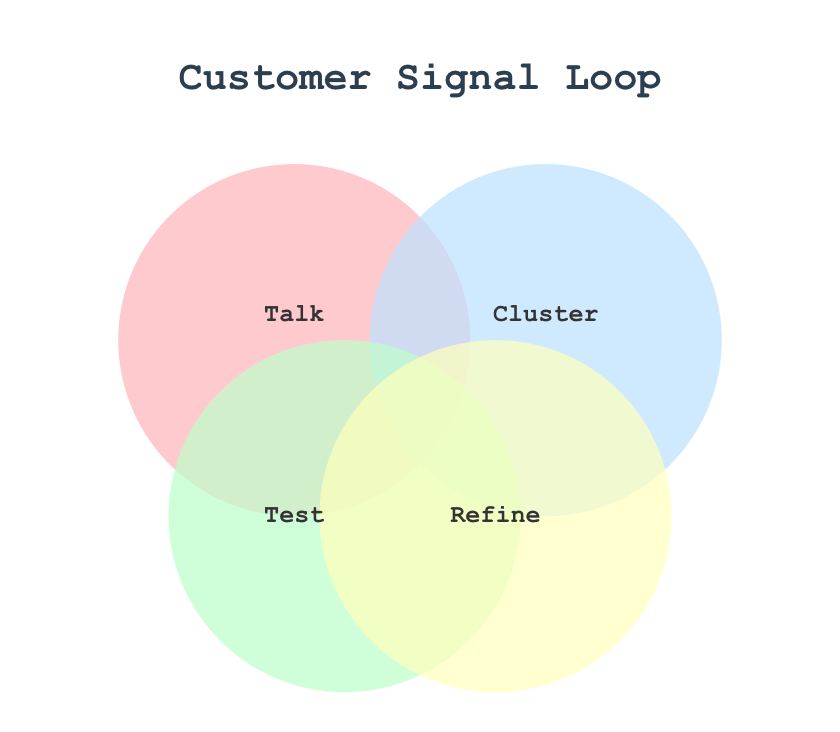
1. Talk → Gather Signals
Conduct interviews, surveys, or in-app prompts.
Goal: Identify what your customers truly think, feel, and do.
Key question: What uncertainties or gaps am I trying to uncover at this stage?
2. Cluster → Make Sense of Patterns
Use AI (or manual analysis) to group responses into themes, personas, or behavior patterns.
Goal: Find meaningful patterns that reveal opportunities or friction points.
Key question: Which insights suggest concrete areas to improve or test next?
3. Test → Validate Hypotheses
Run small experiments on messaging, channels, or product tweaks.
Goal: Learn what actually influences behavior or engagement.
Key question: What improvement am I targeting, and how will I measure success?
4. Refine → Focus and Iterate
Double down on what works, discard what doesn’t, and iterate quickly.
Goal: Convert insights into actionable improvements.
Key question: Does this change move the needle on the gap I identified earlier?
Purpose of the Loop:
Not every insight needs to be viewed through this lens; this is a troubleshooting and optimization framework.
Helps fill gaps between customer understanding and actionable improvements that aren’t resolved by talking or clustering alone.
Encourages testing and refining with a clear signal: “Did this change actually improve the experience or outcome?”
Risks of not doing this:
Talking to the wrong market on the wrong channel → months wasted.
Conversion rates stay flat → revenue stalls.
Generic branding → hard to compete or retain users.
Actionable playbook (do this week)
Gather insights to improve your marketing positioning. DM 10–15 users to ask:
What problem does this product solve?
How would you explain this product to a friend?
What would you do if this product disappeared?
More guidance on this here.
Paste the anonymised responses into ChatGPT accompanied by the prompt below.
Steal this prompt
I have collected [number] customer interviews/responses from my target audience in [industry/niche]. The transcripts are provided below, with clear start and end markers for each:

###transcript 1 begins### [Insert full transcript of interview/response 1 here] ###transcript 1 ends###

###transcript 2 begins### [Insert full transcript of interview/response 2 here] ###transcript 2 ends###

###transcript 3 begins### [Insert full transcript of interview/response 3 here] ###transcript 3 ends###
Task:
Cluster these responses into [number] personas.
For each persona, identify:
Key pain points
Desired outcomes
Language/phrases I should use in marketing
Suggest micro-tests or messaging experiments to validate these insights with minimal spend.
Present your output in a structured, easy-to-read format.
Notes: Ensure that all insights are derived strictly from the transcripts provided, respecting the defined transcript boundaries.
Launch $500 micro-tests on top 2–3 messaging hypotheses.
Track engagement, click-through, and conversions → refine.
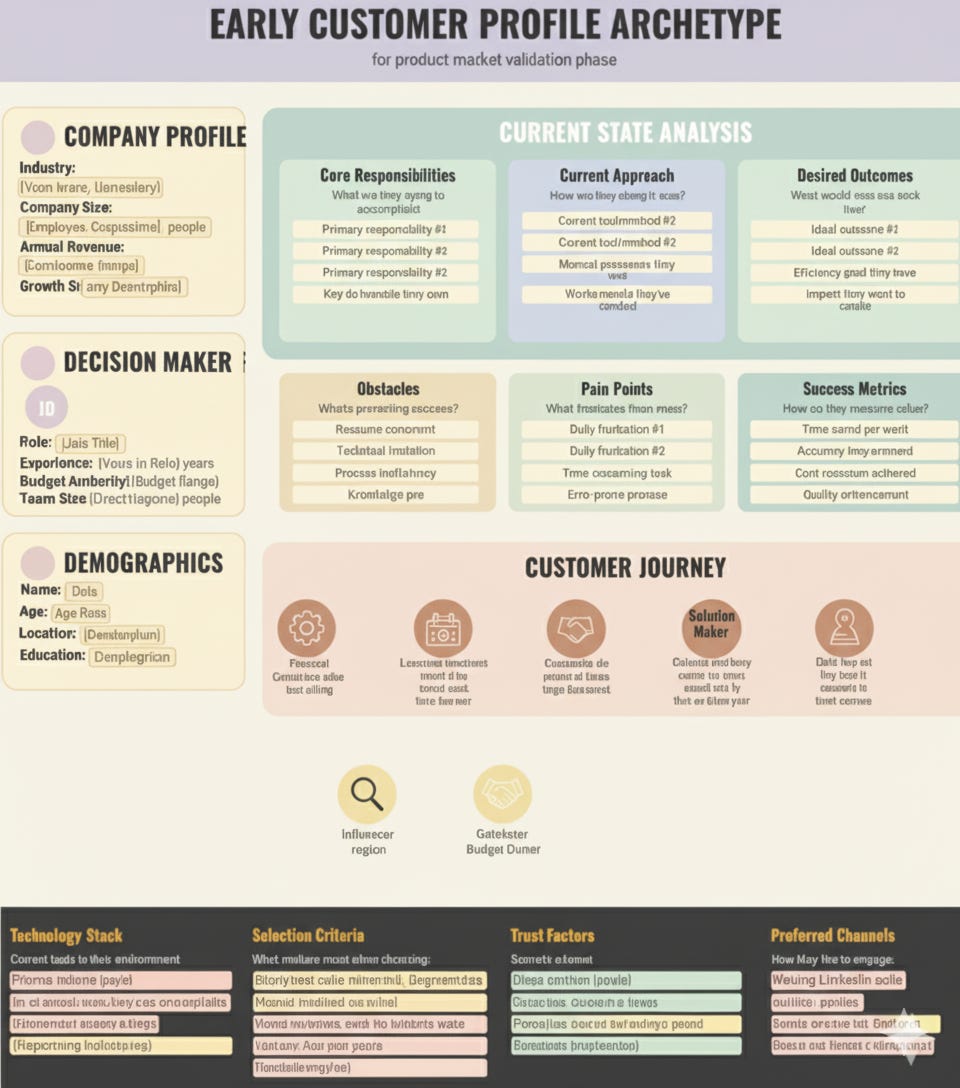
Start to build a picture of your early customer or adopter by filling in the data in this infographic:
B2B Tips
When conducting interviews, ensure your reach out to all members of the “buying committee” (decision-makers, gatekeepers, end users).
If you cannot get Zoom time with some or any of these folks, search for related topics on forums like Reddit and Quora, look at competitor reviews on Trustpilot and Google, and even ask LLMs to serve up insights.
Map competitors by feature set, pricing, and service quality.
Test messaging with account-based campaigns, personalized demos, or pilot programs.
B2C Tips
Segment users by behavioral data, psychographics, and lifestyle relevance.
Track social trends, micro-influencers, and community discussions.
Test messaging with small paid campaigns, landing pages, or app notifications.
More from “Rules of Growth”
Read it now:
1. Where are we in the growth journey today?
2. If we reverse-engineer from (i) revenue goal to (ii) reach required, what would the funnel be?
Coming soon:
4. How can we make our $1 budget work like $10?
5. What scrappy growth moves feel authentic to our company?
6. Let’s zoom in and execute: who is our beachhead persona and our wedge?
Kate Busby is CoFounder of Quiet Edge and a Fractional CMO based in Barcelona, Spain, catch her on X and Instagram. The images are extracted from X and created by MidJourney. No names and identifying details have been changed. Subscribe to Substack to receive all articles in the “Rules of Growth” series straight to your inbox.
🤝 Want to work together? ⏩ Check out the options and let me know how we can join forces.